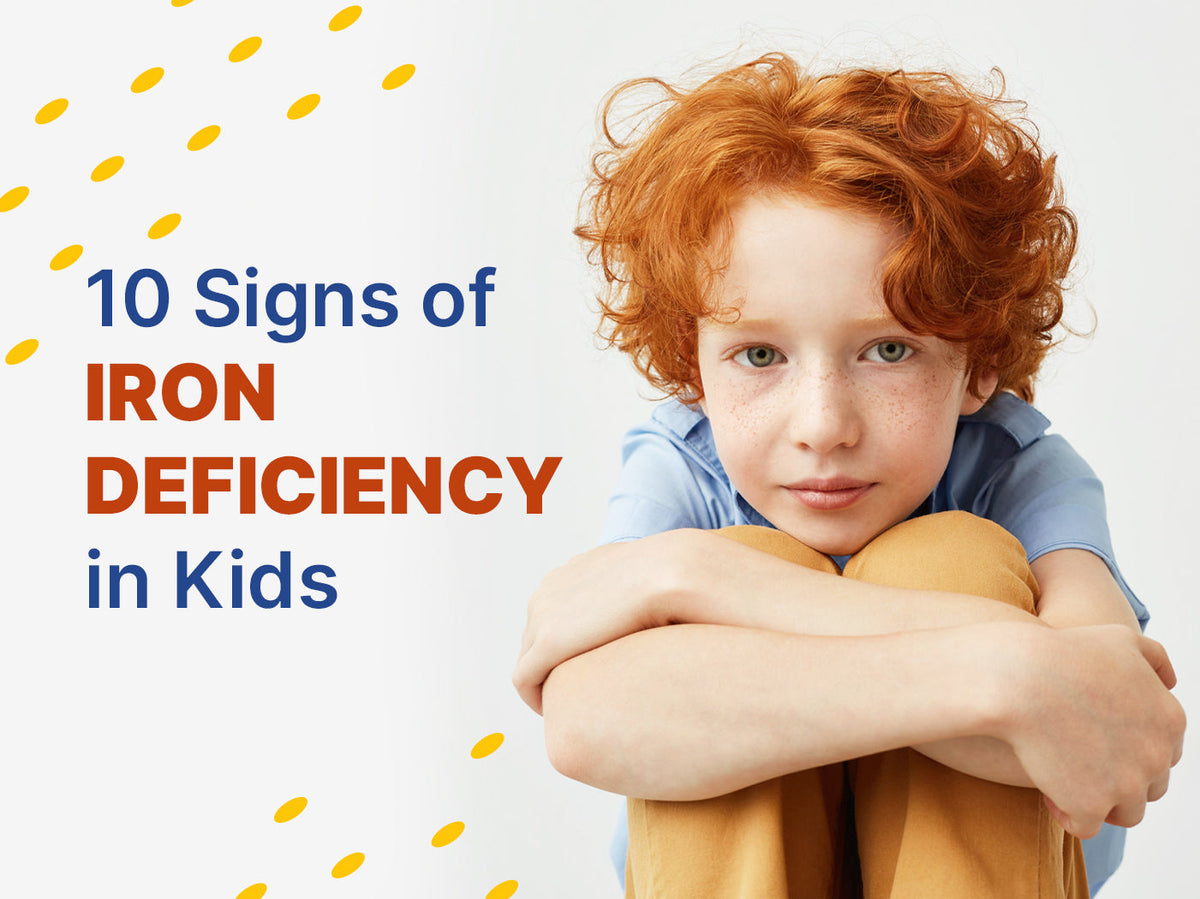

Iron deficiency is one of the most common nutrient deficiencies found in children, and it is also one of the most difficult to recognize. The symptoms never appear in a very clinical form. They will appear in the form of a child who is always tired, irritable for no apparent reason, has lost appetite, or lacks the concentration to do their homework.
Most parents put those things down to a growth spurt, a bad week, or a phase. Sometimes that is exactly what it is. But low iron produces that same cluster of changes, and the numbers say it is worth ruling out: roughly 10% of toddlers aged 1 to 3 are iron deficient, and about half of those go on to develop iron deficiency anemia.
These are the top 10 symptoms of iron deficiency in children. Also included are the symptoms that parents ignore, who is most at risk, and what happens once you visit a pediatrician about your worries.
1. Paleness – Notably pale skin or pale lips and nail beds.
2. Fatigue – Feeling excessively tired despite enough rest.
3. Weakness – Feeling weak or inability to engage in physical activities.
4. Irritability – Mood swings or inexplicable crankiness.
5. Shortness of Breath – Excessive breathing rate during physical activities.
6. Poor Appetite – Low interest in meals or picky eating habits.
7. Delayed Growth – Slower growth in comparison to peers.
8. Frequent Infections – Excessive infections such as colds.
9. Brittle Nails – Nails that crack easily.
10. Difficulty Concentrating – Inability to concentrate in school activities.
What Iron Does in a Child's Body
Iron's best-known job is building hemoglobin, the protein in red blood cells that carries oxygen from the lungs to everywhere else. When there is low iron content in the body, production of red blood cells will be low, and this means each tissue will get slightly less oxygen than required.
But oxygen transportation is not the whole story. The other function of iron is the creation of chemicals such as dopamine and serotonin, which play key roles in our moods and ability to concentrate. This is one of the reasons that iron deficiency manifests itself through behavioral symptoms long before the diagnosis of anemia.
The 10 Signs of Iron Deficiency in Kids
1. Pale Skin, Lips and Nail Beds
Pale skin is often the first visible sign. With less hemoglobin circulating, blood flow to the skin drops and the colour goes with it. The easiest places to check are not the cheeks but the inside of the lower eyelid, the gums, the lips and the nail beds, since those show colour change earlier and are less affected by skin tone.
2. Fatigue That Sleep Doesn't Fix
A child who wakes up tired after a full night's sleep, flags early in the day, or stops wanting to do things they normally enjoy is showing the classic iron symptom. This is no ordinary tiredness at the end of the day. The muscles and brain do not have enough oxygen supply.
3. Weakness and Low Stamina
Children with low iron often tire out faster than their friends during play or sport. They may ask to be carried more, stop halfway up the stairs, or quietly drop out of activities they used to keep up with. Parents frequently describe it as a child who simply has less in the tank.
4. Irritability and Mood Swings
Moodiness without any known cause is one of the most common symptoms reported in children suffering from iron deficiency, and probably the least likely to be linked with nutritional issues. What typically distinguishes this symptom from others is the consistency in its appearance. Having an irritable day is not unusual. But being constantly irritable for days on end with no known cause should be examined further.
5. Shortness of Breath During Play
When your child breathes more heavily than other kids doing the same physical activity, it may mean that the body is compensating for a lack of oxygen capacity. A higher pulse rate is also a possible indicator, because it shows that the body is exerting more effort to distribute the available oxygen.
6. Poor Appetite and Picky Eating
The lack of iron in the body can result in the suppression of the appetite, and this is how it becomes a vicious circle. If a child eats less, their iron intake drops further, which suppresses the appetite again. It is quite common for parents to visit their child's pediatrician complaining about a child who "has stopped eating right."
7. Slower Growth
Iron is required for cell proliferation and development, and thus its prolonged lack may be seen in the growth chart. It is a gradual indicator as opposed to an abrupt one, and can be identified during a routine health examination, where the child's height or weight deviates from their established pattern.
8. Frequent Infections
Iron plays a part in normal immune system function. Kids who lack iron tend to catch illnesses such as colds more often and take longer to recover from them. If your kid is constantly falling ill, it might be a sign of low iron levels.
9. Brittle or Spoon-Shaped Nails
Iron supports the tissues that build nails and hair. Deficiency can leave nails that split, peel or break easily. In long-term cases, iron deficiency leads to nails developing an unusual spoon-shaped appearance referred to as koilonychia.
10. Trouble Concentrating at School
Because iron is involved in dopamine production, low iron affects attention, working memory and processing speed. Teachers may notice that the child becomes distracted, forgets instructions and struggles to stay focused on an activity.
Signs of Iron Deficiency Parents Often Miss
There are four signs which rarely make it into the typical list, yet they are among the most helpful because they are so specific.
- Eating ice. Called pagophagia, this is a well-documented iron deficiency sign. The broader pattern, eating non-food items like dirt, paper or chalk, is called pica, and many pediatricians treat it as a genuine red flag rather than a quirk.
- Restless legs at bedtime. Iron deficiency anemia is one of the most commonly recognized reasons for the development of restless leg syndrome in children. Little children are not able to explain the sensation, so it shows up as kicking, inability to calm down, or frequent awakenings.
- Cracks at the corner of the mouth. Sore, split corners that keep coming back are a recognised sign of low iron.
- Cold hands and feet. Reduced circulation means extremities feel cold more easily than they should.
Which Kids Are Most at Risk of Low Iron
Some children are more vulnerable to deficiency than others, and this is where most deficiencies arise:
- Toddlers drinking too much cow's milk. This is the most important factor of all. The AAP recommends no more than 16 ounces (2 cups) of cow's milk per day after age one. Milk has low levels of iron, makes toddlers feel full so they eat less iron-rich food, impedes iron absorption and can lead to small amounts of gut bleeding if consumed in large quantities. Above 24 ounces a day, risk climbs sharply.
- Picky eaters, especially those who refuse meat.
- Vegetarian and vegan children, who need almost twice as much iron as meat-eaters.
- Teenage girls, because menstruation adds a monthly iron loss.
- Babies born prematurely or at very low birth weight, who start with smaller iron stores.
- Children in a fast growth spurt, whose needs outpace their intake.
How Much Iron Kids Need Each Day
| Age | Meat-eaters | Vegetarians |
|---|---|---|
| 7–12 months | 11 mg | 20 mg |
| 1–3 years | 7 mg | 12.5 mg |
| 4–8 years | 10 mg | 18 mg |
| 9–13 years | 8 mg | 14.5 mg |
| 14–18 years (boys) | 11 mg | 20 mg |
| 14–18 years (girls) | 15 mg | 27 mg |
The vegetarian column is the one that surprises people. The iron obtained from plants is non-heme iron, which is absorbed by the body much more poorly than the heme iron found in meat and fish.
How Iron Deficiency in Kids Is Diagnosed
You cannot diagnose this from symptoms, and that matters, because every sign on this list overlaps with something else.
The AAP recommends screening all children for anemia with a blood test around age one, with repeat testing for higher-risk kids. Two numbers do most of the work. Hemoglobin shows whether anemia has developed — under 11 g/dL in toddlers counts as anemia. Ferritin reflects stored iron, and it falls first, which is why a child can feel awful with a normal hemoglobin. A ferritin under 20 is generally taken as iron deficiency needing treatment.
Ask for ferritin specifically. A hemoglobin result alone can come back normal while iron stores are already low.
Raising Your Child's Iron Levels Through Food
The first step is food, and two habits do most of the work.
Take iron with vitamin C. Vitamin C substantially increases absorption of plant iron. Try strawberries with iron-fortified cereal, oranges with beans, tomatoes with lentils, or peppers in a stir-fry.
Keep milk and iron apart. Calcium competes with iron for absorption, so a large glass of milk with an iron-rich meal works against you. Water at meals, milk between them.
Good sources for children include red meat, chicken thighs, fish, eggs, lentils, beans, chickpeas, tofu, pumpkin seeds, fortified cereals, and dark leafy greens. Cooking in a cast iron pan adds a little more.
When Iron Supplements Can Help
Food is not always enough, and two situations come up repeatedly: picky eaters who refuse most iron-rich foods, and growing teens whose needs have outrun their intake.
The most important warning comes first. Do not give your child any iron supplements before testing, as too much iron can be dangerous. The body cannot easily get rid of excess iron, which builds up and harms organs. Iron overdose is one of the most frequent causes of fatal poisoning in young children, so iron products must be kept out of children's reach. Test first, then supplement only until the numbers are back to normal.
Once the pediatrician confirms an iron deficiency and recommends a supplement, a chewable form is often the easiest option, because iron usually has to be taken daily for months and many children resist tablets and liquids.
SUNNY SAM Iron Gummies for Kids & Teens are built for that stretch:
- 10 mg of iron per serving, to help maintain iron intake
- Vitamin C included, which supports iron absorption
- Low sugar and chewable, so daily consistency is realistic
- Supports normal red blood cell formation and normal immune function
There is also an adult version for parents, which is more relevant than it sounds given how common low iron is in women of reproductive age.
Frequently Asked Questions About Iron Deficiency in Kids
How common is iron deficiency in children?
Common enough that it is the most widespread nutrient deficiency worldwide. In the US, around 8 to 10% of toddlers are iron deficient, and roughly half of those develop iron deficiency anemia. About 18% of infants aged 6 to 12 months do not get enough iron in their diet. Teenage girls are the other high-rate group.
Can I diagnose iron deficiency from symptoms alone?
No. Every symptom on this list can be explained by at least a dozen other factors, which is why iron deficiency both gets overlooked and gets wrongly assumed. The only way to confirm it is a blood test that checks hemoglobin and ferritin levels, so ask for one if your child's symptoms have lasted more than a few weeks.
Can my child have low iron with a normal blood test?
Yes, and this is the most common reason low iron gets missed. A standard anemia screen measures hemoglobin, which stays normal until iron stores are nearly gone. Ferritin drops first. A child can have a normal hemoglobin, a low ferritin, and real symptoms. Ask for ferritin by name.
What's the difference between iron deficiency and anemia?
Iron deficiency means iron stores are low. Anemia means it has gone on long enough that the body can no longer make enough healthy red blood cells. Deficiency comes first and can cause symptoms on its own, which is the whole reason ferritin matters, since it catches the earlier stage.
What are the best iron-rich foods for kids?
In terms of milligrams per serving, the top choices are fortified breakfast cereal (18 mg), white beans (8 mg in one cup), beef liver (5 mg in 3 ounces), followed by lentils, spinach and firm tofu (3 mg in half a cup). Then there are beef, chickpeas, kidney beans, sardines, cashews and baked potato, all of which provide about 2 mg.
Which foods or drinks can block iron absorption?
There are four key inhibitors. Milk and dairy products, because calcium competes directly with iron. Tea and coffee, because their tannins reduce absorption drastically, which matters especially for older children. Whole grains, bran and legumes, because of their phytates. And calcium supplements. You don't need to cut any of them out; just separate them from iron-rich meals by an hour or two.
How much milk is too much for my toddler?
More than 16 ounces, or 2 cups, a day after age one. Milk is both low in iron and an active obstacle to absorbing it, and it fills children up so they eat less of everything else. Toddlers drinking over 24 ounces daily are a well-recognised high-risk group for iron deficiency anemia.
My child won't eat meat. What can I do?
Rely on non-heme foods like lentils, beans, chickpeas, tofu, eggs, iron-fortified cereal and pumpkin seeds, and always pair them with vitamin C, which increases absorption significantly. Avoid milk during these meals. Remember that a vegetarian child needs about twice as much iron as a child who eats meat.
How much food equals one gummy?
One serving of our iron gummies contains 10 mg of iron. Using NIH food values, that is roughly the iron in:
| Food | Amount for ~10 mg of iron |
|---|---|
| Braised beef | about 15 oz (nearly 1 lb) |
| Roast chicken | about 30 oz (nearly 2 lb) |
| Hard-boiled eggs | about 10 eggs |
| Cooked lentils | about 1⅔ cups |
| Cooked spinach | about 1⅔ cups |
| Firm tofu | about 1⅔ cups |
| Beef liver | about 6 oz |
| Fortified breakfast cereal | a little over half a serving |
Two honest notes. These compare iron on the label, not iron absorbed — the body takes up heme iron from meat far more efficiently than non-heme iron from plants, so the plant amounts understate what you would really need. And fortified cereal genuinely beats a supplement on paper, so if your child eats it daily, they may already be fine.
How long does it take to correct low iron levels?
Mood and fatigue may improve after 2–3 weeks, while hemoglobin takes 4–8 weeks to return to normal. But it takes 3–6 months to rebuild iron stores, which is why doctors usually advise continuing well after a child starts feeling better.
Can a child take too much iron?
Yes, and this is the risk to take most seriously. The body has no good way to get rid of excess iron, so it builds up and can harm the liver, heart and pancreas. Even more importantly, iron is one of the most common causes of fatal poisoning in young children, and a handful of tablets or gummies can be enough. Keep all iron-containing products out of children's reach and sight, and never call a vitamin "candy".
Can iron deficiency cause behaviour problems or look like ADHD?
The link is real. Iron is needed to produce dopamine, which is central to ADHD, so iron deficiency can cause distractibility, hyperactivity and trouble following instructions. Studies have found that children with ADHD have lower ferritin levels on average. That does not mean ADHD is simply misdiagnosed iron deficiency, though.
When should I see a doctor about my child's iron levels?
The AAP recommends a screening blood test for every child around age one, with repeat testing for higher-risk kids. After that there is no routine schedule, so later testing usually happens because a parent asks. Book an appointment if:
- Several of these signs exist together, not just one
- Tiredness, irritability or trouble concentrating has been going on for weeks
- Your child chews ice or eats non-food objects
- Your toddler drinks more than 16 to 24 ounces of milk a day
- Your child is vegetarian, a committed picky eater, or a teenage girl with heavy periods
- Your child was born prematurely or at low birth weight
Ask for hemoglobin and ferritin by name, since hemoglobin alone can read normal while stores are already low. Go sooner if there is breathlessness at rest, a racing heart, fainting or dizziness.
Does cooking in a cast iron pan really add iron?
Yes, modestly. Small amounts of iron transfer into food, and more so with acidic foods like tomato sauce and with longer cooking. It is a genuine but small contribution, useful alongside iron-rich meals and vitamin C, not instead of them.
You can check out our full blog about frequently asked questions about iron here.
Shop Here 👇