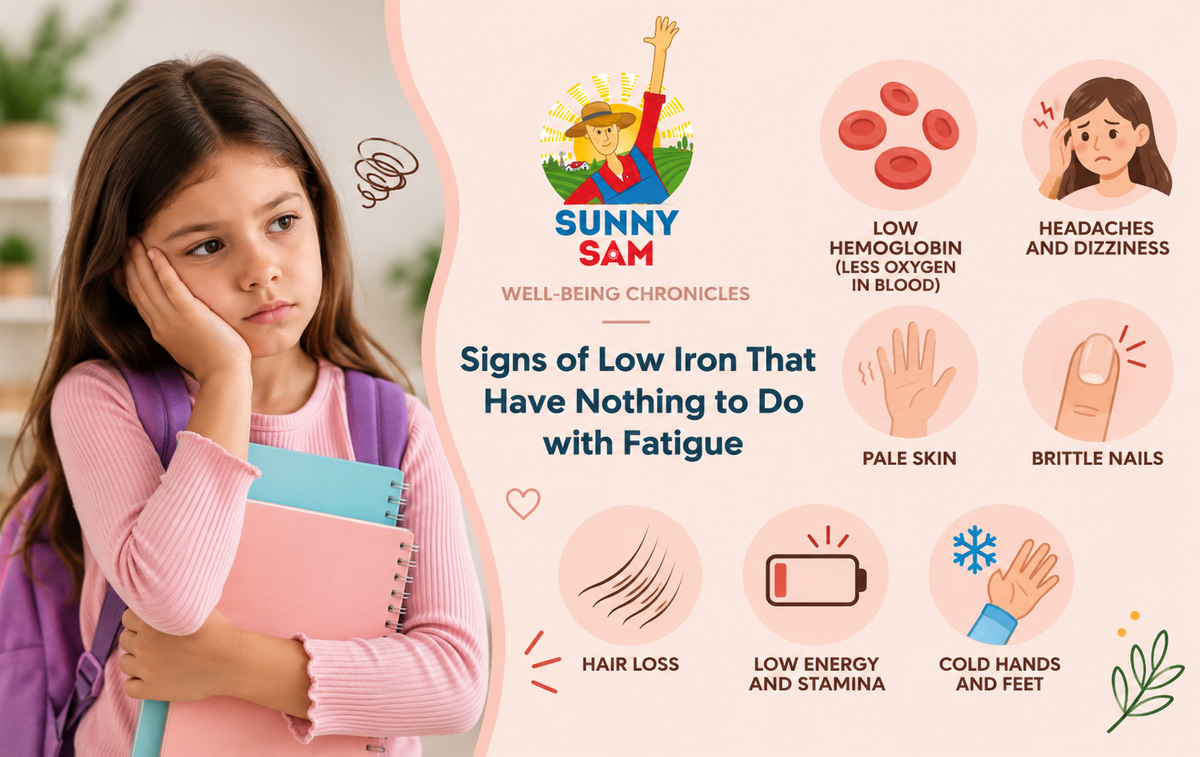

Ask most people what low iron feels like and you'll get one answer: tired. That's fair, since fatigue is the symptom everyone knows. But it's also the reason so much iron deficiency goes unnoticed for years.
Fatigue is a terrible clue on its own. Everyone is tired. Work is tiring, kids are tiring, bad sleep is tiring. So when someone feels worn out, iron is rarely the first thing they think of, and often it's never checked at all.
The more telling signs are the odd ones. The cravings that make no sense. The hair in the shower drain. The stairs that suddenly leave you winded. These are the symptoms that don't get blamed on a busy week, because they don't fit that story.
It's worth knowing them. A 2024 report in JAMA Network Open found that around 34% of American women aged 18 to 50 are iron deficient, and it's rarely screened for during routine checkups.
Here are the signs of low iron that have nothing to do with feeling tired
Unusual Cravings for Ice, Dirt, or Starch
Pica is probably the strangest symptom on this list, and definitely one of the most unusual symptoms related to iron.
It's called pica, the compulsive urge to eat things that aren't food. There are names for the different versions: pagophagia for ice, geophagia for dirt or clay, and amylophagia for raw starch. Ice is by far the most common.
What makes this worth paying attention to is how tightly it tracks with iron. In a classic study of patients with iron deficiency, 22 out of 23 people with ice cravings had the craving disappear completely once their iron was corrected. Another study found ice cravings in 56% of anemic participants compared to just 4% of non-anemic ones.
There's even a plausible reason people crave it. Research found that chewing ice improved reaction time on attention tests, but only in anemic people, not healthy controls. One theory is that the cold triggers a brief increase in blood flow to the brain, producing a small hit of alertness. People describe it like coffee.
Two practical notes. Pica often resolves within a couple of weeks of starting iron, well before anemia itself is corrected. And most people never mention it to their doctor, because chewing a lot of ice doesn't feel like a medical symptom.
Hair Thinning or Increased Shedding
Hair is one of the first things your body gives up on when iron runs short, and the reason is pure triage.
The cells found in the hair follicles are among the quickest-dividing cells in the body; hence, they require constant iron to produce new cells. In times when iron stores are low, your body allocates the available iron to the essential functions that are required for sustaining life such as the production of red blood cells, and hair follicles lose out.
That delay matters. Shedding typically shows up two to three months after iron drops, which is why people rarely connect the two.
The pattern is diffuse thinning across the whole scalp, noticed most when washing or brushing. A receding hairline or thinning crown is a different problem and won't respond to iron.
The measurement that counts here is ferritin, not hemoglobin. Ferritin isn't included in a standard blood panel and has to be requested. Research has linked ferritin under 30 ng/mL to roughly double the risk of diffuse shedding, and many dermatologists aim for 70 ng/mL or higher to support regrowth.
Worth being honest: the evidence is debated. A large Duke study found no significant difference in iron deficiency between women with hair loss and controls. It's a real association, not a settled one.
Pale or Yellowish Skin Tone
Hemoglobin is what makes blood red. When iron is low, you make less hemoglobin, your blood is literally less red, and that shows up in skin and tissue.
The catch is that skin color is a genuinely unreliable place to look. Complexions vary enormously, lighting changes everything, and anemia usually has to be fairly advanced before overall pallor becomes obvious.
There's a far better spot to check, and it takes five seconds. Pull down your lower eyelid and look at the inner lining. In a mirror, in good daylight. It should be a vivid, healthy red. If it looks washed-out pink, or has a pale yellowish cast, that's a recognized sign of iron deficiency.
A 2023 research review found that pallor inside the eyelids and in the creases of the palms is one of the more reliable physical indicators of anemia.
This check matters most for people with darker skin tones, where general pallor may not be visible at all. For many, the inner eyelid and the palm creases are the only places the sign shows up, which is exactly why it gets missed.
None of this replaces a blood test. But it's a useful nudge to go get one, especially alongside other symptoms on this list.
Frequent Headaches or Lightheadedness
Headaches have a hundred causes, so this one is easy to dismiss. Still, the research connecting iron to head pain is stronger than most people realise.
A 2019 study found a correlation between migraine episodes and iron deficiency anemia in women specifically. A 2023 study identified a relationship between iron deficiency anemia and chronic daily headache, with more severe deficiency linked to worse symptoms.
Researchers point to a few possible reasons: reduced oxygen reaching the brain, changes in blood vessel behaviour, and iron's role in dopamine function. In women, the overlap with menstrual blood loss and hormonal shifts likely compounds it.
Lightheadedness has a more direct explanation. Less hemoglobin means less oxygen delivered to the brain. Stand up quickly and there's a lag before your brain gets what it needs, which produces that grey, swimmy, hold-onto-something feeling.
What makes this worth flagging is the pattern rather than the individual episode. Occasional headaches are normal. Headaches that have become noticeably more frequent, especially alongside dizziness on standing, a pounding heartbeat, or any other sign on this list, are a reasonable prompt to get iron checked.
Shortness of Breath During Everyday Activities
It is one of the most useful signs in the list since it is one that has a clearly observable before and after effect, unlike the sign of tiredness.
The cause is very simple. The blood cell hemoglobin is responsible for carrying oxygen from the lungs to the muscles. When you have less iron, you have less hemoglobin, and therefore there is not enough oxygen reaching the muscles
The result is getting winded doing things that never used to wind you. One flight of stairs. Carrying groceries in from the car. Walking uphill at a normal pace while talking. Not a hard workout, ordinary daily activity.
Your heart compensates too, pumping harder and faster to move what oxygen there is. That's why breathlessness often arrives packaged with a pounding or racing heartbeat, and sometimes a jittery, keyed-up feeling that's easy to mistake for anxiety.
Athletes are a high-risk group here, particularly female athletes, and they're often the quickest to notice because they have a clear baseline. Workouts that felt routine start feeling brutal.
One caution: shortness of breath has serious causes beyond iron. If it's new, worsening, or comes with chest pain, that's a same-day doctor conversation, not a supplement question..
Cold Hands and Feet
Being the person who's always cold gets treated as a personality trait. Sometimes it's a circulation problem, and iron sits underneath it.
When oxygen delivery drops, your body makes a sensible decision: it protects the core. Blood flow gets prioritized toward vital organs and reduced at the extremities, where it matters least for survival. Your hands and feet are last in line, so they're the first to feel it.
Physicians describe this as a common presentation, cold hands and feet along with a persistent sense of chilliness, sometimes in rooms where nobody else is cold. It tends to be constant rather than occasional, and it doesn't track neatly with the weather.
cold, and thyroid issues, circulation conditions, and low body weight all produce the same thing.
The value is in combination. Cold hands and feet plus unusual cravings plus increased shedding plus getting winded on the stairs is a cluster, and clusters are worth investigating. If several of these sound familiar, the next step isn't a supplement, it's a blood test. Ask specifically for ferritin, not just hemoglobin, since iron stores drop long before a standard blood count shows anything.
Iron is also the one nutrient where guessing carries real risk. Too much iron builds up in the body and can damage the liver and other organs, so it genuinely needs to be confirmed before you start supplementing.
Once low iron is confirmed and your doctor recommends supplementing, consistency is what does the work. Iron takes months, not days, and gentler formats are easier to stick with than harsh tablets that upset your stomach.
You can check out our full blog about frequently asked questions about iron here
Shop Here 👇
Iron Gummies with Vitamin C for Kids
Iron Gummies with Vitamin C for Adults
This article is for informational purposes only and is not medical advice. These statements have not been evaluated by the Food and Drug Administration. This product is not intended to diagnose, treat, cure, or prevent any disease. Talk to a healthcare provider before starting an iron supplement.