
Zinc is one of those minerals that almost never comes up at a pediatric check-up, right up until it does. Iron gets tested. Vitamin D gets discussed. Zinc tends to sit quietly in the background, even though a growing child needs it for almost everything that growing involves.
And zinc deficiency is not rare. A widely cited global analysis estimated that about 17.3% of the world's population is at risk of inadequate zinc intake — ranging from roughly 7.5% in high-income countries to around 30% in South Asia. In wealthier countries severe zinc deficiency is uncommon, but mild shortfalls are a different story, and children are among the most vulnerable because their zinc needs are high relative to how much food they actually eat.
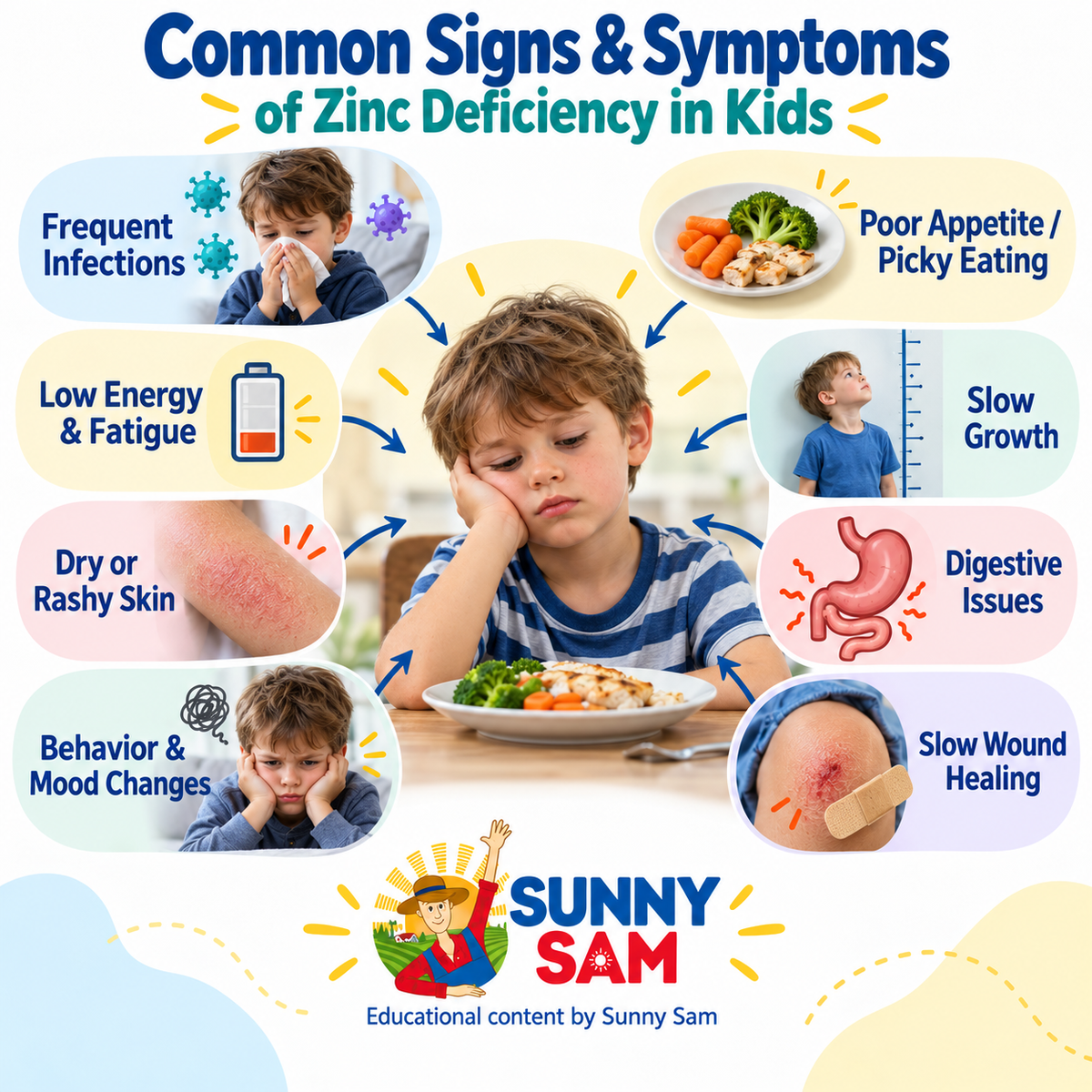
The tricky part is that zinc deficiency in kids rarely announces itself. It shows up as a child who seems to catch everything, whose appetite has quietly disappeared, who has stopped growing along their usual curve, or whose scrapes take a long time to heal. Every one of those has other explanations too, which is exactly why zinc gets missed.
This guide covers what zinc actually does in a child's body, how much zinc kids need at each age, the signs of zinc deficiency worth paying attention to, what causes it, which children are at higher risk, the best food sources of zinc for kids, and when zinc is worth raising with your doctor.
Why Zinc Matters for Growing Children
Zinc is a trace mineral, meaning the body needs it in small amounts — but those small amounts do a disproportionate amount of work.
Zinc is a required component of more than 300 enzymes in the human body, and it is involved in processes that sit right at the centre of childhood: cell division, protein synthesis, DNA synthesis, immune function, wound healing, and the normal development of the senses of taste and smell.
Here is why that matters more for a child than for an adult. Growth is, at a cellular level, cell division and protein building happening at speed. Zinc is required for both. An adult with a mild zinc shortfall is maintaining a body that already exists. A child with a mild zinc shortfall is trying to build one.
The body also has no real zinc storage system. There is no zinc equivalent of the iron stored in ferritin or the vitamin D stored in fat. Zinc circulates and gets used, which means a child needs zinc coming in regularly from food rather than drawing on reserves. Miss it for a stretch and status falls relatively quickly.
That combination — high demand, no storage, and a mineral found mostly in foods children are often fussy about — is why zinc deficiency in kids is more common than parents expect.
How Much Zinc Kids Need by Age
Zinc requirements rise steadily through childhood and jump at adolescence. These are the US recommended intakes alongside the tolerable upper limits, which matter just as much.
| Age | Zinc needed per day | Upper limit per day |
|---|---|---|
| 0–6 months | 2 mg | 4 mg |
| 7–12 months | 3 mg | 5 mg |
| 1–3 years | 3 mg | 7 mg |
| 4–8 years | 5 mg | 12 mg |
| 9–13 years | 8 mg | 23 mg |
| 14–18 years (boys) | 11 mg | 34 mg |
| 14–18 years (girls) | 9 mg | 34 mg |
Two things worth noticing in that table.
The numbers are small, which is the good news. A child aged 4 to 8 needs 5 mg of zinc a day. A single ounce of pumpkin seeds carries 2.2 mg. This is a gap that food can close.
The upper limits are also small, which is the part parents skip. For a 1 to 3 year old the ceiling is just 7 mg a day — barely more than double the requirement. That is a narrow window compared with most nutrients, and it is the single most important reason to check the label on any zinc supplement or zinc gummies intended for a young child. Too much zinc is a real thing, not a theoretical one: sustained excess interferes with copper absorption and can cause nausea and appetite loss of its own.
So the target with zinc is adequacy, not maximum. More is not better.
How Zinc Supports Growth and Development
Zinc's role in growth is not one mechanism but several running in parallel.
Zinc is needed to build proteins, so the raw assembly of new tissue depends on it. It is required for cell division, which is what growth physically is. It plays a part in how the body handles growth hormone and insulin-like growth factor. And it is involved in bone formation and the activity of the cells that build bone.
The population-level evidence lines up with that. The same global analysis that estimated zinc inadequacy found a clear statistical relationship with childhood stunting: average stunting prevalence was 19.6% in countries at low risk of zinc inadequacy, rising to 43.2% in high-risk countries. Supplementation trials in young children in zinc-deficient populations have shown improvements in growth, which is reasonably strong evidence that the relationship runs from zinc to growth rather than the other way round.
An important caveat belongs here, and it is one most articles leave out. Most of that evidence comes from populations where zinc deficiency is common — low- and middle-income countries where diets are plant-heavy and zinc intake is genuinely low. In a well-fed child who already gets enough zinc, extra zinc does not produce extra growth. Zinc fixes a shortage; it is not a growth accelerator.
Zinc and the Immune System
This is the role zinc is best known for, and the research here is both real and more nuanced than the marketing suggests.
Zinc is needed for the development and normal function of immune cells, particularly T cells and neutrophils. When zinc is low, those cells are produced less effectively and respond less well, which is why frequent infections appear on every list of zinc deficiency symptoms.
Where the evidence is strongest is childhood diarrhea. A 2016 Cochrane review of 33 trials found zinc shortened diarrhea by about half a day in children over 6 months, and reduced the chance of it lasting a week or more by 27%. The WHO and UNICEF recommend 20 mg of zinc a day for 10 to 14 days for childhood diarrhea on the strength of this. Worth knowing, though: most of those trials ran in countries where zinc deficiency is widespread, and the effect is likely smaller in a well-nourished child.
Where the evidence is weaker is the common cold, and this is where honesty matters. A 2024 Cochrane review concluded that zinc may shorten a cold by around two days when started after symptoms begin, but that it makes little to no difference to preventing colds in the first place. Certainty was rated low to very low, the effect on symptom severity was unclear, and older reviews found benefit only at doses above 75 mg a day — far above what any children's product contains.
So the fair summary: zinc supports normal immune function, and correcting a zinc deficiency helps a child's immune system work as it should. No zinc product, zinc gummies included, prevents colds. Anyone telling you otherwise is ahead of the evidence.
Wound Healing
Zinc shows up in wound healing for the same reason it shows up in growth: repairing tissue means making new cells and new protein, and zinc is required for both.
Specifically, zinc is involved in collagen synthesis, in the function of the immune cells that clear a wound, and in the cell proliferation that closes it. Low zinc slows each of those steps, which is why slow-healing scrapes, cuts and mouth ulcers are a recognised sign of zinc deficiency.
In practical terms, what parents notice is a child whose ordinary playground injuries hang around longer than they used to, or whose cuts seem to scab and re-open repeatedly. On its own that proves nothing. Alongside other signs, it is worth mentioning to a doctor.
The reverse does not hold, though: giving extra zinc to a child with normal zinc levels does not make wounds heal faster. The benefit is in correcting a shortage, not in topping up past adequate.
Skin Health
The clearest demonstration of zinc's role in skin comes from a rare inherited condition called acrodermatitis enteropathica, in which children cannot absorb zinc properly. It produces a distinctive rash around the mouth, nappy area, hands and feet, along with diarrhea and hair loss — and it resolves with zinc. It is rare, but it shows unambiguously what zinc does for skin.
Milder zinc shortfalls show up more subtly: dry or rough patches, skin that heals slowly, rashes that linger, or cracked, sore corners of the mouth.
Zinc is also widely discussed in relation to acne in older children and teenagers, and some studies have found lower average zinc levels in people with acne. The evidence that zinc supplementation improves acne is mixed rather than conclusive, so it is fair to say zinc supports normal skin function and unfair to present zinc gummies as an acne treatment.
Learning aNutritionnd Concentration
Zinc is present in high concentrations in the brain, particularly in the hippocampus, which handles memory. It is involved in how nerve cells signal to each other and in the development of the nervous system.
Studies in zinc-deficient children have found associations between low zinc status and poorer attention, slower motor development and weaker performance on some cognitive measures, with improvement when zinc is corrected. The effects tend to be clearest where deficiency was real to begin with.
What a parent might notice is a child who seems foggier, harder to engage, or less able to sustain attention on schoolwork — though this overlaps heavily with iron deficiency, poor sleep, and a dozen other things. It is a reason to investigate, not a diagnosis.
Signs of Zinc Deficiency in Kids
The recognised symptoms of zinc deficiency in children, drawn from clinical sources, are: slowed growth, frequent infections, loss of appetite, altered sense of taste or smell, diarrhea, slow wound healing, skin problems, and hair loss.
Here are the four parents are most likely to notice first.
Slow Growth and Delayed Development
This is the most significant sign and the hardest to spot at home, because growth is slow by nature.
What matters is not height on a single day but the trend across a growth chart. A child who has been tracking steadily along the 50th percentile and has drifted down over a year is showing something worth investigating. Zinc deficiency is one of the possible reasons, alongside iron deficiency, coeliac disease, inadequate calories and thyroid problems.
In older children, delayed puberty can also be linked to low zinc, since zinc is involved in sexual maturation.
Practical advice: get your child measured at routine appointments and ask to see the chart. Parents who track the line notice drift months before anyone noticing by eye would.
Frequent Illness and Slow Recovery
Some children genuinely do catch more than others, and most of the time the explanation is ordinary — a new school, a younger sibling in daycare, a bad winter.
What points more towards zinc is the pattern: not just catching more, but taking longer to shake things off, and particularly recurrent diarrhea, which is one of the more specific zinc deficiency signs in children. A child who picks up every bug going and stays ill for a fortnight each time is showing something different from a child who catches three colds and recovers in three days each.
Changes in Taste or Picky Eating
This one deserves more attention than it gets, because it is both specific to zinc and genuinely self-reinforcing.
Zinc is required for normal taste and smell. When zinc is low, food tastes blander — a reduced sense of taste is called hypogeusia — and appetite drops along with it. A child who has become noticeably pickier, who says food tastes "weird" or "like nothing," or who has simply gone off eating, may be describing a zinc problem rather than a behavioural one.
And then the loop closes: low zinc dulls taste, dulled taste means eating less, eating less means less zinc. This is why picky eating sits on both the symptom list and the cause list for zinc deficiency in kids, and why it is worth taking seriously when a child's eating changes rather than having always been that way.
Zinc deficiency also causes loss of appetite directly, independent of taste.
Split Hair and Weak Nails
Hair and nails are built from protein, and zinc is needed for protein synthesis — so hair that breaks easily, thin or brittle nails, and in more significant deficiency hair loss (alopecia), all appear in the zinc literature.
One myth to clear up while we are here, because almost every parent has heard it. White spots on fingernails are not a reliable sign of zinc deficiency. The most common cause by far is minor trauma to the nail matrix — a knock, nail biting, tight shoes — and the spot only becomes visible weeks later, which is why nobody remembers the injury. Studies have not found these spots to correspond with low mineral content in the nail. Zinc deficiency can affect nails, but one or two white spots is not how it shows up.
Why These Signs Can Have Other Causes
This section matters more than any other on the page, so it is worth being direct: every sign above has more likely explanations than zinc deficiency.
- Slow growth is more often about calories, or genetics, or coeliac disease, or thyroid function.
- Frequent infections are usually about exposure — a new school year, daycare, siblings — not nutrition.
- Picky eating is developmentally normal in toddlers and preschoolers, and the overwhelming majority of picky eaters have perfectly adequate zinc.
- Tiredness and poor concentration point to iron deficiency and to sleep far more often than to zinc.
- Brittle nails and hair breakage are usually trauma, styling, or nothing at all.
There is also a testing problem specific to zinc, and anyone writing honestly about it has to say so. There is no reliable, straightforward blood test for zinc status. Plasma zinc is the usual measure, but it drops during infection and inflammation, varies with time of day and recent meals, and does not reflect total body zinc well. This is a real limitation, not a reason for doctors to be dismissive — it is simply why zinc is often assessed from diet, risk factors and symptoms together rather than from a single number.
What all this adds up to: zinc deficiency is worth considering when several signs cluster together in a child who also has a risk factor — a very restricted diet, a vegetarian diet, a gut condition. One symptom on its own, in a child eating a reasonably varied diet, is usually something else.
Causes of Zinc Deficiency in Children
Low zinc in kids comes from three directions: not enough going in, not enough being absorbed, or too much being lost.
Not enough zinc coming in
- A diet low in meat, fish, dairy and eggs, which are the richest and most absorbable zinc sources
- Entrenched picky eating that has narrowed a child's diet to a handful of beige foods
- Vegetarian and vegan diets, unless deliberately planned around zinc
- Diets heavy in refined carbohydrates and low in protein generally
Zinc not being absorbed
- Phytates, the single biggest dietary factor. Found in whole grains, legumes, nuts and seeds, phytates bind zinc and block absorption. Zinc absorption from food ranges from about 5% to over 50% depending on how much phytate the meal contains — a tenfold difference driven by what the zinc arrives alongside.
- Gut conditions including coeliac disease, inflammatory bowel disease and chronic diarrhea
- Very high doses of iron or calcium taken at the same time, which compete with zinc
Too much zinc being lost
- Chronic or recurrent diarrhea, which causes direct zinc loss and is also a symptom of zinc deficiency — a loop that can be hard to break
- Some medications, including certain diuretics
Note that phytate point carefully, because it is the one parents can actually act on. Soaking, cooking, sprouting and fermenting all reduce phytate content, which is why bread made with a long ferment and properly soaked beans deliver more usable zinc than the same foods prepared quickly.
Which Kids Are at Higher Risk?
Some children are meaningfully more likely to run low on zinc:
- Vegetarian and vegan children. A double disadvantage: no meat, and a diet high in the phytates that block what zinc there is. Zinc requirements for a vegetarian child are effectively higher than the table above suggests.
- Committed picky eaters, especially those avoiding meat, fish, eggs and dairy together.
- Children with coeliac disease. Around half of newly diagnosed patients are at high risk of zinc inadequacy or deficiency, and it can persist even on a gluten-free diet.
- Children with inflammatory bowel disease, where 15% to 40% have zinc deficiency.
- Children with sickle cell disease, in whom low zinc status has been linked to shorter stature, lower weight, delayed maturation and more frequent pain crises.
- Exclusively breastfed infants over 6 months, since breast milk alone no longer covers zinc needs past that point and complementary foods matter.
- Children with chronic diarrhea, for the loop described above.
- Premature infants, who start with lower stores.
- Teenagers in a growth spurt, whose requirements jump sharply while diets often get worse.
If your child falls into one of these groups and shows any of the signs above, that is a genuinely good reason to raise zinc at an appointment rather than waiting.
Best Food Sources of Zinc for Kids
Food is where zinc should come from first. These are the figures per standard serving:
| Food | Zinc per serving |
|---|---|
| Oysters, cooked (3 oz) | 28–32 mg |
| Beef, roasted (3 oz) | 3.8 mg |
| Blue crab, cooked (3 oz) | 3.2 mg |
| Oats, cooked (1 cup) | 2.3 mg |
| Pumpkin seeds, roasted (1 oz) | 2.2 mg |
| Pork loin (3 oz) | 1.9 mg |
| Turkey breast (3 oz) | 1.5 mg |
| Cheddar cheese (1.5 oz) | 1.5 mg |
| Lentils, boiled (½ cup) | 1.3 mg |
| Greek yogurt, plain (6 oz) | 1.0 mg |
| Milk, 1% (1 cup) | 1.0 mg |
| Egg, large (1) | 0.6 mg |
Oysters are in a category of their own and are also, realistically, not happening for most children. The practical sources are beef, pork, turkey, cheese, oats, pumpkin seeds, lentils, yogurt, milk and eggs.
Two habits that help:
Pair plant zinc with animal protein. Meat, fish, eggs and dairy improve absorption of zinc from plant foods eaten in the same meal. Lentils with a little cheese or meat deliver more usable zinc than lentils alone.
Reduce phytates where you can. Soak beans and lentils before cooking. Choose properly fermented or sourdough bread. Toast nuts and seeds. Each of these lifts how much zinc actually gets absorbed.
For a child whose diet genuinely cannot reach the target — an entrenched picky eater, a vegetarian child, a teenager living on toast — a supplement is a reasonable conversation to have, and zinc gummies solve the practical problem that children will not reliably take tablets. Two things to check if you go that route: the dose against the upper limit for your child's age, and the serving size on the panel, since a serving of two gummies makes a 60-count bottle a 30-day supply. And keep zinc gummies out of reach — they taste good, and the upper limits for young children are low.
When to See a Doctor
Book an appointment rather than guessing if:
- Your child's growth has drifted off their usual curve on the chart
- Several signs of zinc deficiency are present together rather than one alone
- Your child has recurrent diarrhea, or diarrhea lasting more than a few days
- Appetite or sense of taste has clearly changed rather than always been this way
- Wounds, mouth ulcers or skin problems are persistently slow to heal
- Your child has coeliac disease, IBD, sickle cell disease or another condition on the risk list
- Your child is vegetarian or vegan and you are unsure the diet covers zinc
- There is hair loss, which always warrants a proper look
Two things to go in prepared for. First, ask about iron and ferritin at the same time, because iron deficiency is more common, produces overlapping symptoms, and is far easier to measure. Second, know that plasma zinc is an imperfect test — a normal result does not fully rule out a mild shortfall, and a low result during an infection may not mean much. A good clinician will weigh the diet and the risk factors alongside the number.
And the one firm rule: do not start a zinc supplement at a dose above the upper limit for your child's age without medical advice. Zinc is not harmless in excess — it interferes with copper absorption over time and can cause nausea and appetite loss, which is a particularly unhelpful irony when you started supplementing because your child was not eating.
Zinc-Rich Meal Idea for Picky Eaters
The problem with every "feed them more zinc" list is that the foods are the ones picky eaters already refuse. So here is something that works on actual children.
Cheesy beef and oat mini-meatballs
The trick is oats instead of breadcrumbs. Oats are a decent zinc source in their own right, they bind better than breadcrumbs, and no child has ever detected them.
- 1 lb (450 g) ground beef — the main zinc source
- ½ cup rolled oats
- ½ cup grated cheddar
- 1 egg
- A little grated onion or carrot, fine enough to disappear
- Salt, pepper, mild paprika
Mix, roll into small balls, bake at 400°F / 200°C for about 18–20 minutes. Serve with pasta and tomato sauce, in a wrap, or plain with a dip — most picky eaters accept at least one of those three.
Each portion stacks beef, cheese, oats and egg, so a single serving covers a meaningful share of a school-age child's 5 mg daily zinc target. They freeze well, which matters more than it sounds: the realistic way to improve a picky eater's zinc intake is having something acceptable ready on a bad evening.
Three more that work:
- Pumpkin seed "sprinkles." Blitz roasted pumpkin seeds into a coarse powder and keep a jar on the table. Over pasta, rice, soup or yogurt, it reads as a topping rather than a seed. 2.2 mg per ounce makes this the highest-value trick on the list.
- Overnight oats with yogurt. Oats plus Greek yogurt is around 3 mg of zinc before anything else goes in, and it is one of the few breakfasts you can make the night before.
- Cheese-and-egg muffins. Egg, cheddar and whatever vegetable your child tolerates, baked in a muffin tin. Portable, freezable, and zinc-dense.
One last thing worth repeating. Most picky eaters are fine, and most children eating a diet with some meat, dairy or eggs in it get enough zinc. The point of knowing the signs of zinc deficiency in kids is not to worry about every fussy phase — it is to recognise the small number of children for whom something more is going on, and to get them looked at properly.
Keep Reading
- Frequently Asked Questions About Zinc — dosage, timing, side effects and what to take zinc with.
- Top 10 Supplements Every Growing Child Needs — where zinc fits alongside iron, magnesium and vitamin D.
Shop Here 👇
Anastasia Glover writes about family nutrition and children's well-being for the Sunny Sam Well-Being Chronicles.
This article is for informational purposes only and is not medical advice. These statements have not been evaluated by the Food and Drug Administration. This product is not intended to diagnose, treat, cure, or prevent any disease. Speak with your pediatrician before starting a zinc supplement for your child, and keep all supplements out of reach of children.