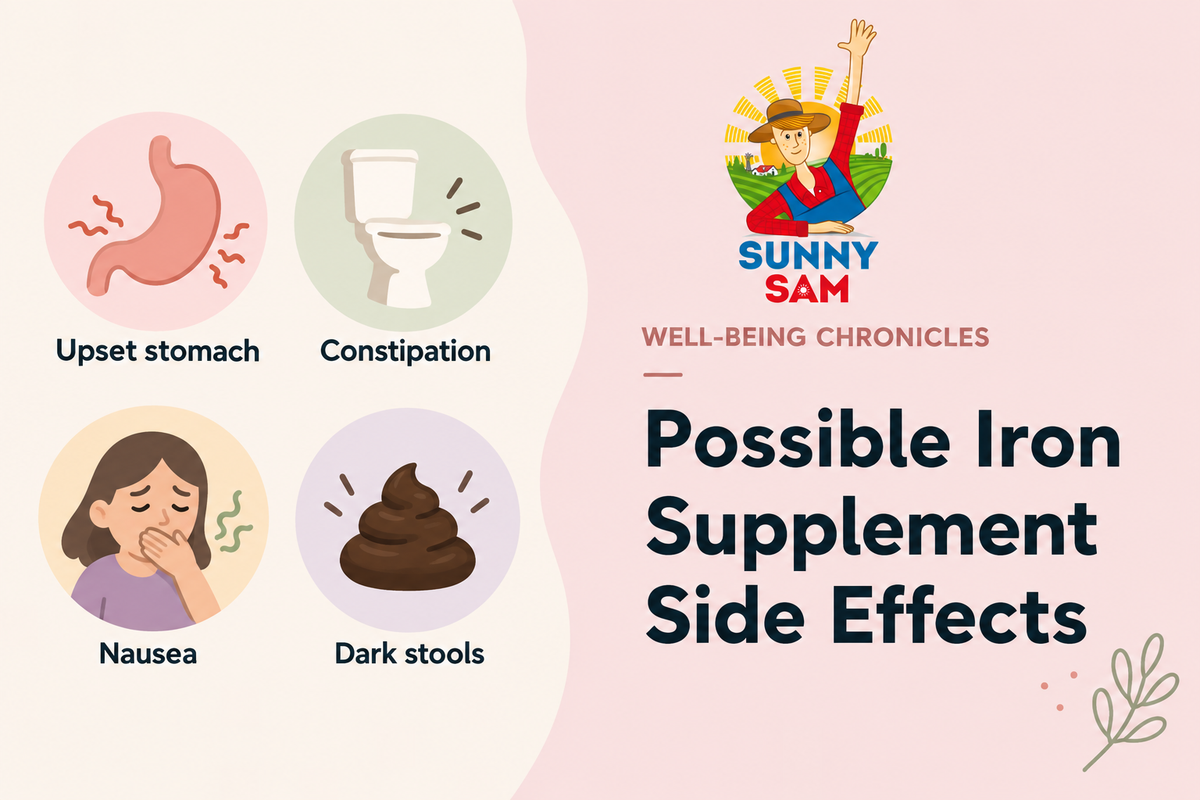

Iron supplements have a bit of a reputation, and it's not entirely undeserved. Anyone who's started taking iron for low levels or anemia has probably heard a friend or family member say something like "just wait, your stomach won't be happy about it." That reputation exists for a real reason. Research pooling data across multiple studies found that gastrointestinal side effects show up in roughly 35 percent of people taking standard iron supplements, compared to about 22 percent on placebo, which tells you the discomfort is genuinely tied to the iron itself and not just coincidence.
That said, side effects from iron don't mean something is wrong, and they definitely don't mean iron isn't worth taking. Iron deficiency comes with its own list of problems, fatigue, weakness, trouble concentrating, so the goal here isn't to scare anyone away from supplementing. It's to help people understand what's actually happening in their body when iron causes discomfort, which symptoms are simply normal and expected, and which ones are worth a call to a doctor. Iron is one of those nutrients where the difference between "annoying but fine" and "something to flag" really does matter.
This article walks through the most common iron supplement side effects one at a time, explains the biology behind why iron behaves this way in the digestive system, and covers practical ways to make iron easier to tolerate, including why so many people, especially parents shopping for a child's supplement, have started switching to iron gummies instead of traditional pills. Whether iron is new to your routine or you've been dealing with stomach issues for a while, this should give a clearer picture of what's normal and what's not.
Stomach Pain and Abdominal Discomfort
Stomach pain is one of the most commonly reported complaints when people start taking iron, and there's a straightforward biological reason behind it. Most traditional iron supplements, ferrous sulfate especially, release iron in a form that isn't fully absorbed by the gut. That leftover, unabsorbed iron doesn't just pass through quietly. It reacts with the lining of the stomach and intestines, generates oxidative stress, and can directly irritate the tissue it comes into contact with.
For some people, this shows up as a mild, generalized discomfort. For others, it's a more specific, tight or heavy feeling in the upper abdomen, sometimes described as cramping or spasming. Iron supplements can activate nerve endings in the stomach lining that trigger these sensations, and the effect tends to be more pronounced when iron is taken on an empty stomach, which is unfortunately also when iron absorbs best. It's a frustrating trade-off that a lot of people run into: take iron on an empty stomach for better absorption and risk more pain, or take it with food and reduce the discomfort at the cost of somewhat lower absorption.
In rare cases, iron sitting in the stomach for extended periods can lead to something called iron-pill gastritis, where iron deposits actually irritate and damage the stomach lining enough to cause erosions. This is uncommon and usually associated with higher doses or prolonged use of harsher iron salts, but it's part of why persistent, severe stomach pain from iron shouldn't just be pushed through indefinitely. Switching to a gentler iron formulation, adjusting timing, or trying iron gummies instead of a hard tablet are all reasonable first steps before assuming iron simply isn't an option.
Constipation and Iron Supplements
Constipation might be the single most universally reported complaint about iron supplements, and it happens for a few overlapping reasons. Iron has a direct effect on gut motility, meaning it slows down the muscle contractions that normally move food and waste through the intestines. When things move more slowly, stool has more time to lose water and become harder, which is the basic mechanism behind constipation from almost any cause.
On top of that, unabsorbed iron interacts with the bacteria living in the gut. Some of these bacteria respond to the extra iron in ways that can further firm up stool and contribute to gas and bloating alongside the constipation itself. Research on oral iron supplementation has consistently found constipation rates somewhere around 12 percent among people taking standard iron, making it one of the most predictable side effects across the research, not an unusual reaction.
The good news is that constipation from iron is very manageable in most cases. Staying well hydrated, increasing fiber gradually, and staying physically active all help counter the slowed motility iron can cause. Some people find real relief simply by switching iron formulations, since gentler, chelated forms like iron bisglycinate tend to cause noticeably less constipation than traditional ferrous sulfate. For kids specifically, this is a big reason iron gummies have become such a popular alternative, since many are formulated with these gentler iron sources and tend to be easier on a smaller digestive system than a hard, concentrated tablet. If constipation becomes severe, causes significant pain, or doesn't improve with basic lifestyle adjustments, it's worth bringing up with a doctor rather than just pushing through it.
Why Iron Supplements Can Turn Your Stool Dark
This is probably the most alarming-looking side effect of iron, right up until someone explains what's actually going on. It's extremely common for stool to turn a dark green, gray, or black color while taking iron supplements, and in the vast majority of cases, it's completely harmless. Unabsorbed iron reacts with sulfur compounds naturally present in the digestive tract, and that chemical reaction is what produces the darker color. It's essentially the same basic chemistry behind why a cut apple turns brown when exposed to air, just happening inside the gut instead.
This is worth mentioning to a doctor at your next appointment if it's new, mostly so it's documented and expected rather than a surprise, but it's not something that typically requires any action on its own. Iron manufacturers and pharmacists are well aware this happens, which is why it shows up as a routinely listed side effect on iron supplement labeling rather than something hidden or unusual.
Where it gets more important to pay attention is distinguishing normal iron-related stool darkening from something more serious. True gastrointestinal bleeding can also cause dark, black stool, but it typically has a distinct tarry, sticky texture and a notably foul odor, sometimes described as looking like coffee grounds. If dark stool from iron is accompanied by stomach pain, dizziness, unusual fatigue, or if the stool looks tarry rather than simply darker in color, that combination is worth contacting a healthcare provider about fairly promptly. On its own, though, iron-related stool discoloration is one of the more benign, cosmetic side effects on this list, even though it tends to catch people off guard the first time they notice it.
When Side Effects May Indicate Too Much Iron
Most of the side effects covered so far are uncomfortable but expected at normal supplemental doses. Taking too much iron, however, is a genuinely different situation, and it's worth understanding the difference clearly, especially in households with young children, since iron overdose has historically been one of the leading causes of accidental poisoning deaths in kids under six.
Iron toxicity tends to progress in stages. The first stage, usually within the first six hours after a significant overdose, involves direct irritation to the gastrointestinal tract: vomiting, sometimes with blood, diarrhea, and abdominal pain that's noticeably more intense than typical supplement-related discomfort. This can be followed by a deceptive period where symptoms seem to improve, before a more serious phase sets in as excess iron begins affecting cells and organs throughout the body, sometimes causing metabolic disturbances, low blood pressure, or liver stress. This delayed, two-phase pattern is part of what makes iron overdose particularly dangerous, since the apparent improvement can lead people to assume the danger has passed when it hasn't.
Doses in the range of 60 milligrams of elemental iron per kilogram of body weight are generally considered capable of causing serious toxicity, though experts note there isn't a perfectly established threshold, and smaller amounts can still cause problems in young children. If a child has swallowed an unknown or large number of iron pills or gummies, this counts as a genuine medical emergency, even if the child seems fine in the first hour, since symptoms can be delayed. This is also a strong argument for keeping any iron supplement, gummy or pill, stored well out of reach, since iron gummies formulated to taste appealing to kids can unfortunately make overconsumption more tempting if left accessible.
When to Speak to Your Healthcare Provider
Most people tolerate iron supplements reasonably well once they find the right formulation and routine, but certain signs genuinely warrant a conversation with a doctor rather than just waiting things out. Severe or worsening abdominal pain, especially pain that doesn't ease up after a dose wears off, is one of the clearer signals something beyond normal iron-related discomfort might be happening.
Stool that looks truly black and tarry, rather than simply darker than usual, deserves attention, particularly if it's accompanied by dizziness, unusual paleness, rapid heartbeat, or fatigue that feels disproportionate to how someone's been sleeping or eating. These can be signs of gastrointestinal bleeding, which is a separate issue from the harmless discoloration iron normally causes, and it's not something to self-diagnose from home. Persistent vomiting, especially if it contains blood or looks like coffee grounds, is another symptom that should prompt a same-day call rather than a wait-and-see approach.
It's also worth checking in with a healthcare provider if side effects are severe enough that someone keeps skipping doses or wants to stop iron altogether, since studies have found that GI side effects lead to non-adherence in up to 40 percent of people prescribed oral iron. A doctor can often solve this by adjusting the dose, switching to a different iron formulation, recommending alternate-day dosing, or suggesting a gentler option like iron gummies instead of a standard tablet. Iron deficiency doesn't resolve on its own, so working through side effects with a provider's guidance, rather than quietly abandoning treatment, tends to lead to much better outcomes in the long run.
Tips for Taking Iron Supplements Safely
A few practical adjustments go a long way toward making iron easier to tolerate, and most of them are backed by fairly consistent research rather than just anecdotal advice. Iron absorbs best on an empty stomach, but for anyone dealing with nausea or stomach pain, taking it with a small amount of food is a reasonable trade-off that most healthcare providers actively recommend rather than discourage.
Timing matters just as much as whether food is involved. Calcium, dairy products, caffeine, and high-fiber foods like whole grains and raw vegetables can all interfere with how well iron gets absorbed, so spacing these out from an iron dose by a couple of hours tends to help. On the flip side, pairing iron with a source of vitamin C, whether that's a supplement or a glass of orange juice, can meaningfully improve absorption, since vitamin C helps convert iron into a form the gut absorbs more easily.
Splitting a daily dose into two smaller doses, rather than taking it all at once, can reduce nausea for a lot of people without sacrificing the total amount absorbed. Some research has also pointed to alternate-day dosing as a genuinely effective strategy, since the body's iron-regulating hormone, hepcidin, temporarily blocks additional absorption for about a day after each dose, meaning taking iron every single day doesn't necessarily improve results and may just add unnecessary side effects. Finally, and this matters especially for households with kids, all iron supplements, including iron gummies, should be stored in a child-resistant container, out of reach and out of sight, since even products designed for children can pose a real risk if a young sibling gets into them unsupervised.
Choosing the Right Type of Iron Supplement
Not all iron supplements are built the same way, and the specific form of iron in a supplement has a real, measurable effect on how well it's tolerated. Ferrous sulfate is the most common and least expensive option, and it's been used and studied for decades, but it's also the form most strongly associated with nausea, constipation, and stomach pain. Research comparing it to placebo found meaningfully higher rates of GI side effects, which lines up with why so many people who try ferrous sulfate first end up looking for alternatives.
Ferrous gluconate is a gentler relative of ferrous sulfate, generally causing less stomach upset, though it typically requires taking more tablets to reach the same total iron dose, since each tablet contains somewhat less elemental iron. Iron bisglycinate has emerged as a genuinely different approach entirely. It's a chelated form, meaning the iron is bound to amino acids in a way that allows it to be absorbed through a different pathway in the gut, one that isn't as sensitive to stomach acidity or as likely to trigger the irritation associated with traditional iron salts. Comparative studies have found iron bisglycinate produces similar or better improvements in iron levels while causing significantly fewer GI side effects, even at lower doses than ferrous sulfate.
For anyone who's tried standard iron and struggled with side effects, switching formulations before giving up on supplementation altogether is genuinely worth trying. This is also where format comes into the conversation, since iron gummies frequently use gentler iron sources specifically because they're easier to formulate into a pleasant-tasting chewable, giving people a second lever to pull, both a gentler iron compound and a format that's simply easier to take consistently.
How Iron Gummies Are Better Than Pill Form
Given everything iron can put a digestive system through, it makes sense that iron gummies have become such a popular alternative to traditional tablets, and the appeal goes beyond just taste. Many iron gummies are formulated using gentler iron compounds, like iron bisglycinate, specifically because these forms hold up better in a chewable, flavored format and are already known to cause less stomach irritation than harsh iron salts like ferrous sulfate.
There's also a practical adherence angle that matters more than people tend to realize. Since GI side effects cause up to 40 percent of people on standard iron pills to stop taking them altogether, a format that's genuinely easier to tolerate and look forward to taking, rather than dread, translates directly into more consistent use. Iron only works if it's actually taken regularly, and a supplement sitting half-finished in a cabinet because someone couldn't handle the stomach pain isn't doing anyone any good. Iron gummies remove a lot of that friction, particularly for kids who already resist swallowing pills, or for adults who've had rough experiences with iron in the past and are hesitant to try again.
Chewing itself also plays a small role here, since it begins breaking the supplement down before it ever reaches the stomach, which can mean a more gradual release compared to a compact tablet that has to dissolve as a single dense unit. That gentler, more gradual delivery is part of why gummies tend to sit better with sensitive stomachs. The one thing worth keeping in mind with iron gummies specifically is storage and dosing discipline, since their pleasant taste means they need to be treated with the same child-safety precautions as any other iron supplement, kept well out of reach and taken according to labeled directions rather than treated like a snack.
Here are some frequently asked questions about Iron
Do Iron Supplements Make You Gain Weight?
Iron itself doesn't cause weight gain, since it's a mineral, not a calorie source. A 2014 study on iron deficiency anemia actually found the opposite: correcting low iron led to weight loss. Any weight change from iron supplements usually traces back to appetite returning.
Can Iron Supplements Cause Headaches?
Headaches are a recognized, though less common, side effect of iron supplements. They're usually tied to constipation or taking iron on an empty stomach, not iron itself. Interestingly, research on iron-deficient people found headaches actually decreased once iron supplementation corrected the deficiency.
How Fast Do Iron Supplements Work?
Iron supplements start entering your bloodstream within 30 minutes to 2 hours. Energy and fatigue often improve within one to two weeks of consistent iron supplements. Iron gummies work the same way biologically, so consistency matters more than format.
If you are interested in other frequently asked questions check out our full blog here
Shop Here 👇
Iron Gummies with Vitamin C for Kids
Iron Gummies with Vitamin C for Adults