
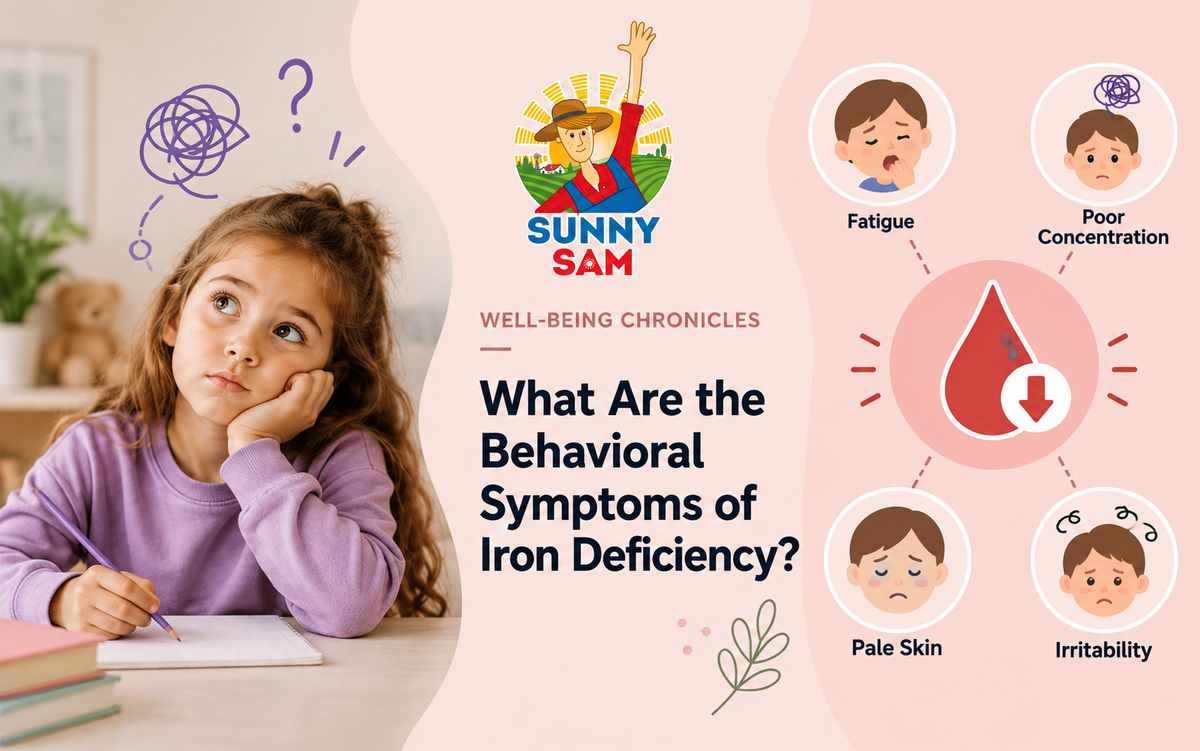

When most parents think about iron deficiency, they picture the classic stuff: pale skin, tiredness, maybe a doctor mentioning low hemoglobin at a checkup. What catches a lot of families off guard is how much iron deficiency shows up as behavior long before it shows up as anything physical. A kid who's suddenly harder to reach emotionally, who seems checked out at school, or who can't seem to settle down at bedtime isn't automatically dealing with a discipline problem or a phase. Sometimes it's iron, quietly running low in the background.
Iron isn't just about carrying oxygen through the blood, even though that's the role most people learn about in school. It's also deeply involved in how the brain makes and uses dopamine and serotonin, the two neurotransmitters most responsible for mood, motivation, and focus. So when iron stores drop, the effects aren't limited to feeling tired. They ripple outward into mood regulation, attention span, motivation, and sleep, often in ways that look a lot like other conditions parents may already be worried about, including ADHD.
This is part of what makes iron deficiency such a sneaky thing to catch. Research has repeatedly shown that behavioral changes can show up well before a child becomes anemic in the technical, lab-result sense. A child can be iron deficient without being anemic and still show noticeable shifts in how they act, react, and engage with the world around them. This article walks through the specific behavioral symptoms tied to low iron, organized around the areas where parents tend to notice changes first: mood and emotional regulation, motivation and cognitive performance, and attention and sleep, including a couple of less commonly discussed signs worth knowing about.
How Iron Deficiency Affects Mood and Emotional Regulation
Mood is often where iron deficiency shows up first, and it's also where it gets misread most easily. A child who's suddenly more irritable, quicker to cry, or harder to calm down after being upset isn't necessarily going through a difficult stage. Iron plays a direct role in how the brain produces serotonin and dopamine, the neurotransmitters most responsible for emotional stability, and when iron stores run low, that production process doesn't run as smoothly as it should.
Researchers have found that children with iron deficiency are more likely to show signs of emotional dysregulation, meaning it takes them longer to calm down once they're upset, and smaller things tend to set them off in the first place. This isn't the same as a child simply having a bad day. It's a pattern, one that tends to persist and often gets more noticeable over time rather than resolving on its own. Some studies have also connected early childhood iron deficiency to a higher likelihood of anxiety and low mood later on, suggesting that the emotional effects of low iron aren't always short-lived, especially when the deficiency isn't caught and corrected early.
What makes this tricky for parents is that emotional symptoms of iron deficiency can look almost identical to typical childhood moodiness, especially in toddlers and young kids who don't yet have the vocabulary to explain what they're feeling. The difference tends to come down to intensity and duration. Occasional crankiness is normal. A consistent pattern of emotional volatility that seems disproportionate to whatever triggered it, especially alongside other symptoms like fatigue or pale skin, is a more reasonable signal to bring up with a pediatrician and consider whether iron levels are worth checking.
Signs of Iron Deficiency That Appear in Children's Behavior
Beyond general mood shifts, there's a more specific cluster of behavioral changes that researchers and pediatricians have consistently linked to low iron in kids, and a lot of them are subtle enough that parents chalk them up to personality rather than nutrition. Increased wariness and hesitance is one of the more well-documented patterns, particularly in infants and toddlers. Children with iron deficiency have been observed to be more cautious in new situations, less likely to explore independently, and more likely to stay close to a parent during play instead of venturing out the way iron-sufficient kids typically do.
Reduced social engagement is another pattern that shows up in the research. A child who used to dive into group play might start hanging back, watching from the sidelines instead of jumping in. This isn't shyness in the usual sense, it's more of a diminished interest or energy for the kind of social interaction that used to come naturally. Alongside this, many parents describe a general dampening of positive affect, meaning the child seems less enthusiastic, less easily delighted, and generally flatter in their emotional responses than they used to be.
Iron deficiency has also been associated with a specific and fairly distinctive behavior called pica, which is the urge to eat non-food items like ice, dirt, paper, or chalk. Ice craving specifically, sometimes called pagophagia, shows up often enough in the iron deficiency research that many pediatricians treat it as a genuine red flag worth investigating rather than a quirky habit. If a child suddenly develops an intense urge to chew ice or eat things that aren't food, it's worth mentioning to a doctor, since it's one of the more specific behavioral signs tied to iron deficiency rather than something that overlaps with a dozen other possible explanations.
Common Emotional Changes Associated With Low Iron Levels
Zooming in further on the emotional side of things, a few specific changes come up again and again across the research on iron deficiency in kids. Increased anxiety is one of the most consistent findings, and it makes sense given iron's role in serotonin production, since serotonin is heavily involved in regulating anxious responses. Kids with low iron may seem more worried about things that didn't used to bother them, more clingy in unfamiliar situations, or generally more on edge than their baseline personality would suggest.
Irritability deserves its own mention here because it's genuinely one of the most commonly reported symptoms across nearly every study on childhood iron deficiency. It's also one of the hardest for parents to pin on nutrition, since irritability has about a hundred possible causes on any given day, from a skipped nap to a rough morning at school. What tends to distinguish iron-related irritability is its persistence. It doesn't come and go with an obvious trigger, it lingers as more of a low hum in the background of a child's temperament, day after day, week after week.
Some children with low iron also show what researchers describe as diminished positive affect, essentially a flatter emotional range overall. They may still get upset normally, but the highs, the excitement, the delight, the enthusiasm that usually comes so naturally to kids, seem muted. Parents sometimes describe this as their child seeming "less like themselves," which, vague as it sounds, is actually a pretty accurate way to describe what iron deficiency can do to a child's emotional presentation. Correcting the underlying iron deficiency, once confirmed through testing, has been associated in multiple studies with gradual improvement in these emotional patterns, though it typically takes weeks to months rather than days.
Low Motivation and Reduced Cognitive Performance
Motivation and cognitive performance are two areas where iron deficiency does some of its most underappreciated damage, mostly because the symptoms look so much like ordinary laziness or a lack of effort, when in reality something biological is getting in the way. Iron is a required cofactor for an enzyme called tyrosine hydroxylase, which the brain needs to produce dopamine. Dopamine isn't just about mood, it's central to motivation, reward processing, and the mental drive to start and stick with tasks. When iron runs low, dopamine synthesis becomes less efficient, and the downstream effect is a child who seems to have lost their spark for activities they used to enjoy.
This shows up in very recognizable, everyday ways. A kid who used to be enthusiastic about homework, sports, or creative projects might start showing up half-hearted, disengaged, or reluctant to even begin. Task initiation specifically tends to suffer, meaning the hardest part isn't finishing something, it's getting started in the first place. Teachers sometimes describe these kids as unmotivated or checked out, without realizing that a nutritional gap could be sitting underneath that behavior.
Cognitively, iron deficiency has been linked to slower processing speed, weaker working memory, and more difficulty with tasks that require sustained mental effort. Multiple meta-analyses looking at iron supplementation in school-age children and adolescents have found measurable improvements in cognitive test scores after iron levels were corrected, which is fairly strong evidence that these effects aren't just correlational quirks in the data but a real, causal relationship between iron status and how a child's brain functions day to day. For a child struggling in school, ruling out iron deficiency is a reasonable, low-cost step worth taking before assuming the issue is purely about effort or ability.
Attention Problems, Restlessness, and Weird Sleep Patterns
Attention and sleep are two areas where iron deficiency overlaps so heavily with ADHD symptoms that researchers have spent years trying to untangle where one ends and the other begins. Because iron is essential for dopamine production, and dopamine dysfunction is one of the core features of ADHD, a child with low iron can end up looking remarkably similar to a child with an actual attention disorder, distractibility, difficulty sitting still, trouble following multi-step instructions, all present and accounted for.
Several studies have found that children diagnosed with ADHD tend to have significantly lower ferritin levels, the marker doctors use to measure the body's stored iron, compared to kids without an ADHD diagnosis. This doesn't mean every case of ADHD is secretly iron deficiency in disguise, that would be an oversimplification the research doesn't support. But it does suggest a meaningful overlap worth taking seriously, especially since some clinical trials have found that correcting iron deficiency in kids with low ferritin improved attention and impulsivity scores, even in children who already carried an ADHD diagnosis.
Restlessness is another piece of this puzzle, and it shows up in a very specific, well-documented way: restless legs syndrome. Iron deficiency is one of the most consistently identified risk factors for pediatric restless legs syndrome, a condition where kids experience an uncomfortable, hard-to-describe sensation in their legs that creates an urge to move them, especially at night. Younger children often can't articulate this the way older kids or adults can, so instead of describing tingling or discomfort, they might just seem unable to settle down at bedtime, kick their legs constantly, or wake up repeatedly through the night, feeding right back into daytime irritability and attention problems.
How Iron Deficiency May Affect Sleep and Daily Routines
Sleep is one of the clearer windows into a child's iron status, mostly because iron deficiency tends to disrupt it in fairly specific, recognizable ways rather than just causing generic tiredness. Beyond restless legs syndrome, researchers have also identified something called restless sleep disorder, a condition marked by frequent large body movements throughout the night, more awakenings, and reduced time spent in deep, restorative sleep stages. Kids with low ferritin levels show up disproportionately in studies of both conditions, and encouragingly, many of them respond well once iron levels are corrected through diet or supplementation.
The daytime consequences of this kind of fragmented sleep are where things start to snowball. A child who isn't sleeping well because of restless legs or frequent nighttime waking is going to show up the next day with less patience, shorter attention span, and lower emotional resilience, regardless of what's actually causing the poor sleep in the first place. This creates a frustrating loop for parents, since the daytime behavior, irritability, hyperactivity, trouble focusing in class, often gets addressed on its own without anyone connecting it back to what's happening at night, let alone back to iron.
Daily routines tend to suffer in more indirect ways too. A consistently under-slept child often struggles more with transitions and shows less resilience when things don't go according to plan. Parents sometimes describe a kind of unraveling that happens by late afternoon, when a child who held it together in the morning starts falling apart after school. Poor-quality sleep driven by an underlying iron deficiency is a genuinely underrecognized contributor to this pattern, which is why pediatric sleep specialists have started recommending iron checks as a routine part of evaluating kids with chronic sleep complaints.
When to Talk to Your Doctor About Iron Deficiency
Given how many of these behavioral symptoms overlap with completely normal childhood ups and downs, or with other conditions like ADHD, it's fair to wonder when a parent should actually bring iron into the conversation with a pediatrician rather than just waiting things out. The honest answer is that a cluster of symptoms matters more than any single one on its own. One cranky week doesn't mean much. But a consistent pattern of irritability, low motivation, attention trouble, and disrupted sleep, especially appearing together, is a much stronger signal worth acting on.
Certain risk factors also raise the odds that behavioral changes are tied to iron specifically. Picky eaters, kids who drink a lot of cow's milk instead of eating iron-rich foods, toddlers who transitioned off formula early, and children going through rapid growth spurts or the early stages of puberty are all at higher risk of running low on iron, simply because their bodies need more of it than their diet is reliably providing. A family history of restless legs syndrome or iron deficiency is another detail worth mentioning at an appointment, since genetics do seem to play a role in who's more susceptible.
The good news is that checking iron status is straightforward. A simple blood test measuring ferritin, the protein that reflects the body's stored iron, gives a much clearer picture than guessing from symptoms alone, and it's a test most pediatricians are perfectly comfortable ordering if a parent raises the concern. Iron deficiency is also very treatable once identified, whether through dietary changes, supplementation, or in more significant cases, more targeted medical treatment. Catching it earlier tends to mean a faster, fuller recovery in both mood and behavior, which is really the whole reason it's worth paying attention to in the first place.
Changes in mood, concentration, or energy can sometimes be linked to low iron levels, but it's important to seek medical advice for an accurate diagnosis. When iron supplementation is recommended, iron gummies provide a simple, great-tasting way to support healthy iron intake and overall wellbeing.
Here are Some Frequently Asked Questions About Iron
How Long Does It Take Iron Supplements to Work?
Most people feel less tired within 2 to 3 weeks of taking iron supplements consistently. Hemoglobin normalizes within 4 to 8 weeks, but full iron stores can take 3 to 6 months. Doctors usually recommend continuing iron supplements past feeling better to fully replenish reserves.
Can I Take Iron Supplements at Night?
You can take iron supplements at night, and some people prefer it, especially if daytime nausea from iron is an issue. Just keep it away from calcium, coffee, or tea, since these reduce absorption. Consistency matters more than the actual hour.
Digestion Related Questions
Iron supplements are well known for stirring up digestion, and that reputation is fair. Below are the most common digestion questions people ask about iron, from diarrhea to stool color.
You can check out our full blog about frequently asked questions about iron here
Shop Here 👇