
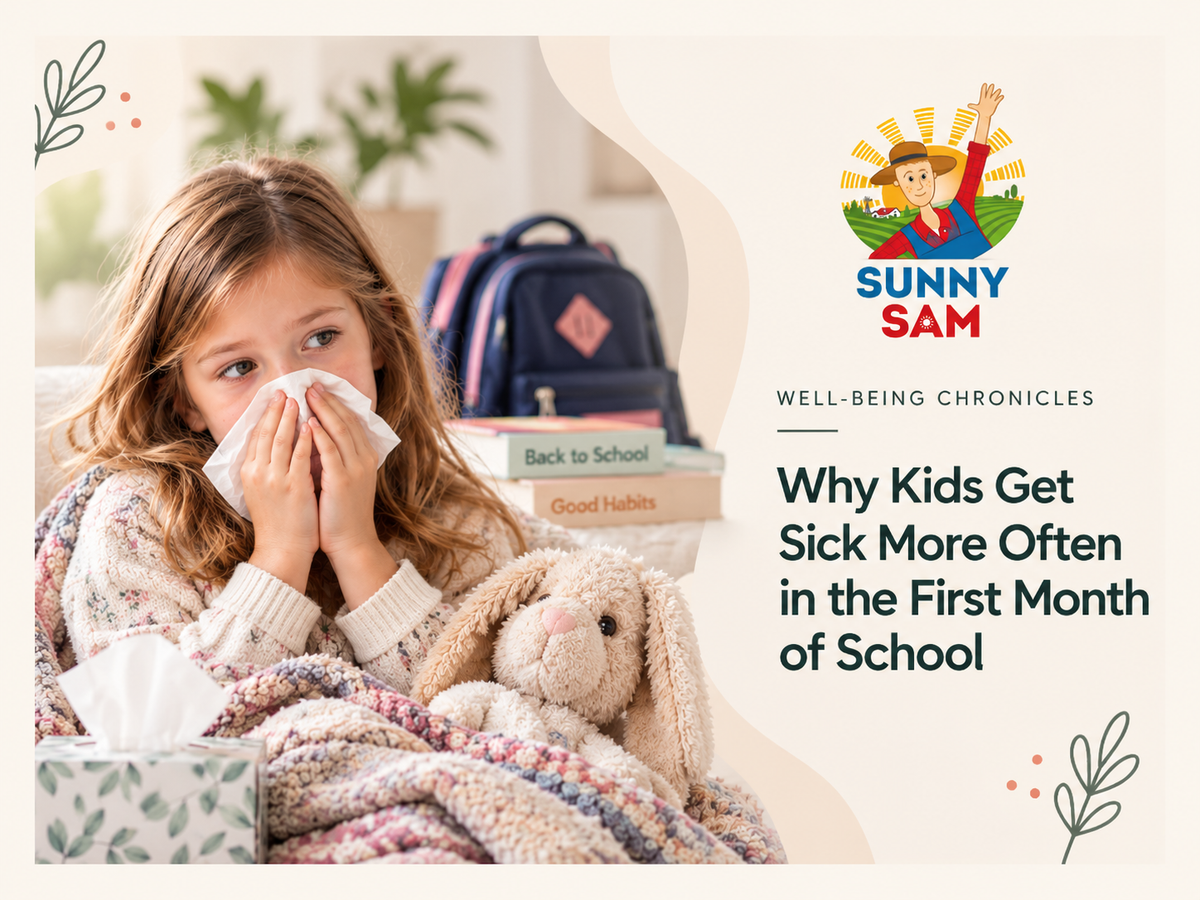

Every parent knows the pattern. Your child spends a healthy summer outdoors, goes back to school, and within three weeks the whole house has a cough.
It feels like bad luck. It isn't. The spike in illness after school starts is one of the most predictable patterns in children's health, and researchers have been tracking it for decades.
Here is how predictable it actually is. Studies of asthma hospitalizations in children found a sharp, reliable peak every single year in the third week of September, roughly two to three weeks after school returns. In Canada, around 25% of all childhood asthma hospitalizations happen in that one month. Researchers gave the phenomenon a name: the September epidemic.
What makes it fascinating is what happened next in the data. The peak hit school-age children first. About a week later, a smaller peak appeared in preschool-age children. Then another in adults. The researchers described school children as disease vectors, carrying viruses home and passing them to younger siblings and parents in a chain you can literally see in hospital records.
So when your whole family gets sick in late September, you are watching a well-documented pattern, not a coincidence. Let's look at why it happens and what actually helps.
The Sleep Disruption Factor
Summer bedtimes drift. That is normal, and most families let it happen because there is no reason to fight it in July.
The problem is what happens when the alarm suddenly goes off at 6:45 a.m. in September. A child who has been going to bed at 10 p.m. and waking at 9 a.m. now has to be awake two hours earlier, and bedtime rarely shifts fast enough to compensate. The result is a child starting the school year already carrying a sleep debt.
That matters for immune function. Deep sleep is when the body releases cytokines, proteins directly involved in fighting infection and inflammation. Research has linked chronic short sleep in children to reduced natural killer cell activity and a weaker antibody response after vaccination.
For reference, the CDC guidance is:
- Ages 3–5: 10–13 hours per 24 hours, including naps
- Ages 6–12: 9–12 hours per night
- Ages 13–18: 8–10 hours per night
A child who begins September short on sleep walks into a classroom full of circulating viruses with less capacity to fight them off. Sleep is genuinely the first domino here, and it is also the easiest one to fix.
Group Settings Speed Up Illness Spread
The second factor is simple arithmetic. Over the summer your child interacted with a handful of people. In September they are in a room with 25 children for six hours a day, sharing desks, door handles, pencils, and air.
Young children are also efficient spreaders, not through any fault of their own but because of how they behave. They touch their faces constantly, they are still learning to cover coughs, and hand-washing is rarely thorough without a reminder.
Rhinovirus, the main cause of the common cold, is the dominant virus in early autumn. There are more than 200 viruses that cause colds, so catching one in September provides no protection against the next one going around in October.
This is also why the illness rarely stays at school. The September epidemic research showed the transmission chain clearly: school-age children get infected first, then bring it home to younger siblings and parents about a week later.
One reassuring note. Most children get 6 to 8 colds a year, and children in daycare get more. Frequent colds by themselves are usually not a sign that something is wrong with your child's immune system. What matters more is how well they recover in between.
Common Illnesses That Spike in September
Knowing what is actually circulating helps you respond sensibly rather than worry about everything.
Common colds. By far the most frequent. Rhinovirus leads the way in early autumn. Symptoms usually appear 1 to 3 days after exposure and last about a week, sometimes up to two.
Asthma flare-ups. The best documented September spike. Driven mainly by rhinovirus infection, made worse by lapsed summer medication routines and higher levels of ragweed and mold at this time of year.
Stomach bugs. Children typically get 2 to 3 diarrheal illnesses a year, and shared surfaces at school make autumn a common time for them.
Ear infections. Often follow a cold rather than appearing on their own, which is why they cluster in the same weeks.
Hand, foot and mouth disease. More common in younger children and daycare settings, and it spreads quickly once it appears.
Strep throat. Bacterial rather than viral, and it becomes more common once children are back in close contact.
Most of these are viral, which means antibiotics do nothing for them. Fluids, rest, and time do the actual work.
How Nutrition Habits Shift When School Starts
This one gets overlooked, but the change is real and it happens fast.
Summer eating tends to be relaxed and varied. There is time for a proper breakfast, fresh fruit is around, and meals are less rushed. Then September arrives and mornings compress into twenty minutes.
What typically changes:
- Breakfast gets skipped or reduced to something quick and beige
- Packed lunches come home half-eaten, so actual intake drops
- Fresh fruit and vegetables get replaced by shelf-stable snacks
- Water intake falls, since many children drink less at school
- After-school activities push dinner later and make it simpler
None of this is a parenting failure. It is what happens when a schedule tightens. But nutrients like iron, zinc, and vitamin D support normal immune function, and children who are already low on them going into the school year have less to work with.
Picky eaters are particularly affected, since research shows they are at higher risk of falling short on iron, zinc, and vitamin D specifically. Vitamin D is worth its own mention, because natural production drops as outdoor time falls and the days shorten.
The practical goal is not perfection. It is keeping something protein-based in the morning and something fresh in the lunchbox, even on rushed days.
The Summer-to-School Immune System Adjustment
There is a common belief that children's immune systems get weaker over the summer. That is not quite right, and the real explanation is more interesting.
Immune systems do not weaken from disuse. What actually changes is exposure. Over the summer, children encounter fewer respiratory viruses because they spend more time outdoors, in smaller groups, and in better-ventilated spaces. Rhinovirus transmission drops considerably.
Then September arrives and exposure jumps sharply in a matter of days. It is not that defenses fell; it is that the challenge suddenly multiplied.
There is a second piece specific to asthma. Researchers studying the September epidemic noted that many families quietly stop daily controller medication during the summer, when symptoms are mild. When viral exposure spikes again, that protection is not in place. Studies suggested the epidemic could be reduced by restarting effective controller therapy before school returns, which is a genuinely useful thing to raise with your pediatrician in August.
It is also worth saying plainly: catching common viruses is a normal and useful part of how a child's immune system develops. The goal is not to shield children from every germ. It is to give their bodies decent conditions to handle the ones they meet.
Steps Parents Can Take to Minimize Early Illness
You cannot prevent every September cold. You can meaningfully reduce how many and how hard they hit.
Start the sleep shift early. Move bedtime and wake time earlier by 15 to 30 minutes every few nights, beginning one to two weeks before school starts. A gradual shift works far better than a sudden change on day one.
Rebuild the hand-washing habit. Twenty seconds with soap and water, covering backs of hands, between fingers, and under nails. Community hand-washing education reduces respiratory illness by roughly 16% to 21%.
Protect breakfast. Something with protein beats a rushed bowl of cereal for keeping energy steady through the morning.
Talk to your pediatrician in August, not October. Particularly if your child has asthma or allergies. Restarting controller medication before the September spike is far more effective than reacting after it.
Stay current on vaccines. Flu vaccination is recommended annually for everyone 6 months and older, ideally by the end of October.
Keep sick children home. Hard to arrange, but it is how the chain gets broken for everyone.
Support nutrition consistently. Iron, zinc, magnesium and vitamin D all play roles in normal immune function, and these work through steady daily intake over weeks rather than a rush of effort once someone is already ill.
To be straight about expectations: no supplement prevents colds, and any product claiming otherwise is overselling. What nutrients do is help fill genuine dietary gaps, which matters most for picky eaters and during the exact stretch when school routines squeeze mealtimes.
Your child will still catch things this autumn. That is school, and it is part of growing up. But a well-rested, well-fed child who washes their hands tends to get sick less often, recover faster, and miss fewer days.
Shop Here 👇
Browse All Products
---
This article is for informational purposes only and is not medical advice. These statements have not been evaluated by the Food and Drug Administration. This product is not intended to diagnose, treat, cure, or prevent any disease. Speak with your pediatrician about your child's specific needs.