

By Anastasia Glover
Most parents expect the first few weeks of school to bring home a cold. What fewer parents expect is that the nerves leading up to it may be part of the reason.
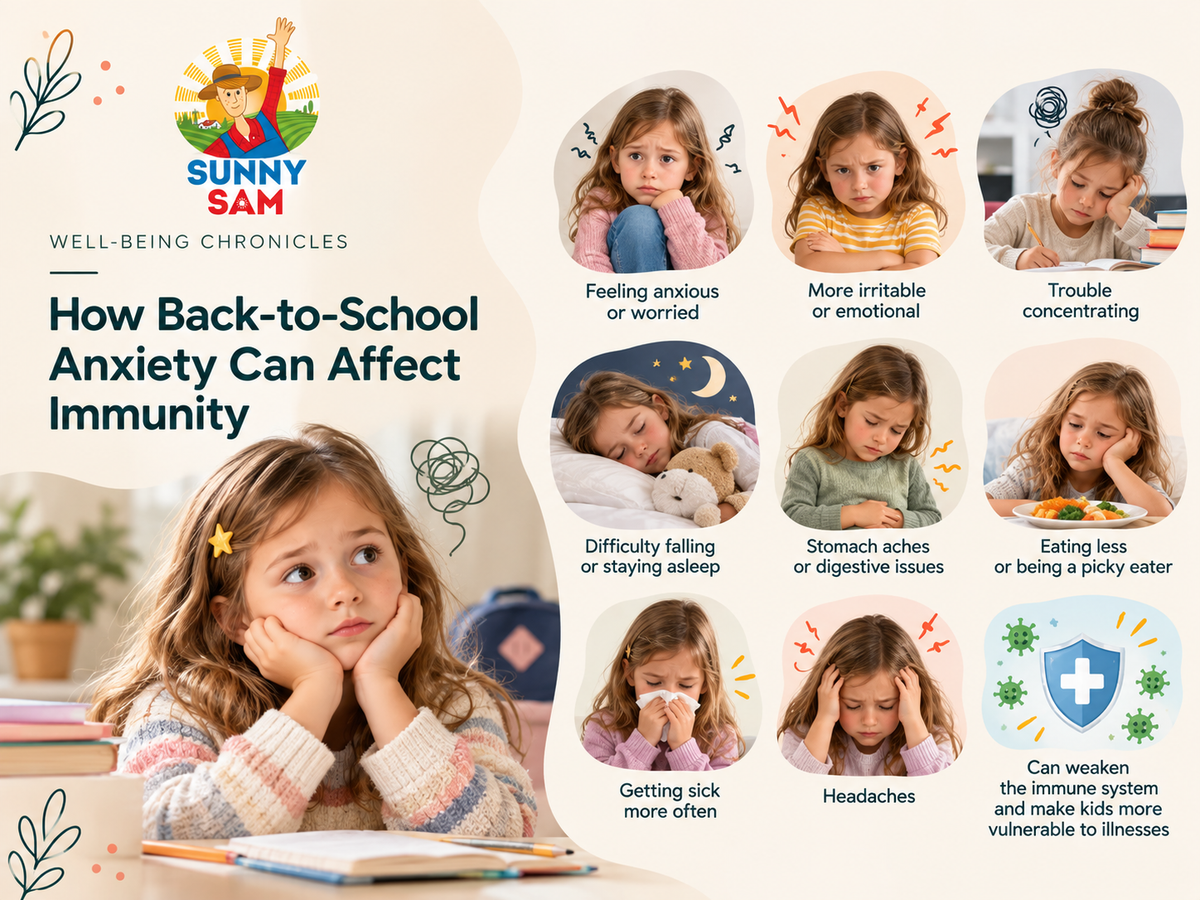
Back-to-school anxiety is easy to spot in some children and almost invisible in others. One child says outright that they are worried about their new teacher. Another says nothing at all, sleeps badly for a week, and then comes down with a sore throat on the second Monday of term.
There is a large body of research behind that pattern. The best summary of it is still a review published in Psychological Bulletin by Suzanne Segerstrom and Gregory Miller, who pulled together more than 300 studies covering 30 years of research on stress and the human immune system. Their conclusion was not that stress is bad for immunity in a vague, general way. It was more specific and more useful than that.
They found that short-term, real-life stressors, and they named school exams as the example, suppress cellular immunity while leaving another part of the immune system largely intact.
Cellular immunity is the side of your immune system that handles viruses inside your cells, which is exactly the side you want working well in September.
And one finding in that review matters more for parents than any other. Children's and adults' own reports of how stressed they felt generally did not match the immune changes measured in their blood. A child who says they are fine can still be showing a measurable immune shift.
So the question is not really whether back-to-school anxiety affects immunity. The research suggests it does. The useful question is how it happens, and what actually helps.
The Mind-Body Link Between Stress and Immunity
The relationship between stress and immunity was once thought of as lying on the fringes of medicine. This is no longer the case, as there is an entire field dedicated to studying the connection, known as psychoneuroimmunology, and its central tenet is quite clear: The mind and immune system are continuously communicating with one another.
This communication is very literal; nerves extend directly into the lymph nodes, spleen and thymus, the sites of production and storage of immune cells. Immune cells themselves are equipped with receptors to receive stress hormones; a hormone triggered because your child is stressed about catching the bus can literally land on a white blood cell. There is no divide between “emotional” and “physical” when it comes to this system.
Where the review by Segerstrom and Miller came in to provide additional information was in terms of time frames, and that is where school-induced stress enters the equation..
Very short stressors, the kind that last minutes, actually increase some immune activity. This is the fight-or-flight response doing something sensible. If you are about to be injured, more immune cells in circulation is a reasonable preparation.
Brief real-life stressors, the kind that last days or weeks, behave differently. The immune system does not shut down. It shifts. Cellular immunity drops while antibody-based immunity is preserved. The researchers described this as the immune system changing priorities rather than simply weakening. Unfortunately, the part that gets deprioritized is the part that handles respiratory viruses.
Long-running stressors, the kind that go on for months with no clear end, suppress both sides. This is the most damaging pattern of the three.
The first month of school sits squarely in the middle category. A new classroom, a new teacher, a new social group and new expectations is not a few minutes of stress and it is not, for most children, a chronic condition. It is a brief, intense period of adjustment, which is the pattern most closely linked to reduced cellular immunity.
It is worth being honest about the size of the effect. Stress does not make a child defenseless. What the research suggests is a shift in the odds, arriving at the same time as a classroom full of new germs. Those two things together explain the September pattern better than either one alone.
What Happens to the Body During Stress Responses
To understand why anxiety reaches the immune system at all, it helps to follow the sequence. It is faster and more mechanical than most people imagine.
It begins in the amygdala, a tiny part of the brain which serves to recognize threats.
The amygdala does not differentiate between physical and social threats; entering a new classroom is just as threatening as approaching the road.
Two distinct pathways become activated after that point.
The first is fast. Nerve signals travel to the adrenal glands, which release adrenaline within seconds. Heart rate rises, breathing quickens, blood is redirected to the large muscles. This is the part children can feel: the racing heart, the shaky hands, the stomach ache before school. It is also the part that fades quickly once the situation passes.
The second is slower and matters more here. It is a chain called the HPA axis:
- The hypothalamus releases a signaling hormone
- That signal reaches the pituitary gland, which releases another
- That second signal travels in the blood to the adrenal glands
- The adrenal glands release cortisol
Cortisol takes minutes rather than seconds, and it stays in circulation far longer than adrenaline. This is the hormone that carries stress into the immune system.
A single cortisol response is not a problem. It is a normal, healthy system doing its job, and children need it. The body is built to switch it on, deal with the situation and switch it off again.
The difficulty with back-to-school anxiety is that the situation does not pass. School is there again tomorrow. So instead of one spike followed by a return to baseline, you get a pattern of repeated activation, morning after morning, sometimes for weeks. And a stress response that never fully switches off is a different thing from a stress response that does.
There is a digestive angle too, which many parents notice first. Stress slows digestion, which is why an anxious child often loses their appetite or complains of stomach ache before school. Since a large share of the body's immune tissue sits in and around the gut, appetite that drops for two weeks has its own knock-on effect. A child eating less is also getting less of the nutrients their immune system runs on.
Cortisol's Role in Suppressing Immune Function
Cortisol is where the mind-body link stops being a theory and becomes something you can measure in a blood sample.
Here is the clearest way to see it. Cortisol belongs to a family of hormones called glucocorticoids. When doctors need to deliberately calm an overactive immune system, in severe asthma, in an autoimmune flare, after an organ transplant, they prescribe drugs from that same family. Prednisone and hydrocortisone are synthetic versions of the hormone your child's own body releases when they are anxious.
In other words, cortisol is a natural immune suppressant. That is not a side effect. It is one of its jobs, and in the short term it is useful, because it stops an immune response from running out of control and damaging healthy tissue.
The problem is the dose and the duration. When cortisol stays elevated for weeks, several
things happen to immune function:
• Lymphocyte numbers fall. Lymphocytes are the white blood cells, T cells and B cells, that recognize and attack specific invaders. A 2025 retrospective hospital study published in Curious examined this directly and found that cortisol levels were negatively correlated with lymphocyte percentage. Higher cortisol, fewer lymphocytes as a share of white blood cells.
• Lymphocytes multiply less readily. When your immune system meets a virus it needs to rapidly clone the specific cells that recognize it. Cortisol slows that process, so the response is not just smaller, it is later.
• Cytokine production changes. Cytokines are the chemical messages immune cells use to coordinate with each other. Cortisol dampens several of the ones involved in fighting viruses, so the response is less well organized.
• Immune cells move out of the bloodstream. Cortisol changes where immune cells are distributed in the body, which alters how quickly they reach a site of infection.
Then there is the effect that explains the most puzzling part of all this. Under sustained high cortisol, immune cells become less responsive to cortisol itself. Researchers call this glucocorticoid resistance. The cells effectively stop listening to the signal.
This sounds like it should be protective, and it is not, because cortisol's message to the immune system includes "stop inflaming things now." When immune cells stop hearing that message, inflammation carries on unchecked. So chronic stress produces an immune system that is worse at fighting viruses and worse at switching off inflammation once it starts. Both halves of the regulation break down at once.
This is the biological reason a stretched-out period of worry is more harmful than an intense but short one. It is not that the stress is stronger. It is that the system loses its off switch.
How Stress Affects Sleep and Why That Compounds Immune Risk
Everything above describes what anxiety does to immunity directly. But there is a second route, and in practice it may do more of the damage, because it is where stress and immunity feed back into each other.
Anxious children sleep worse. That is not a controversial claim, and the mechanism is straightforward: cortisol is an alerting hormone. It is supposed to be low in the evening and rise before waking.
An anxious child's cortisol is doing the opposite, staying elevated into the evening, which makes falling asleep harder. Add a mind that is busy rehearsing tomorrow and you get a child lying awake at 9:30 p.m. after a day they found genuinely difficult.
And short sleep, on its own, has one of the most striking pieces of evidence in this whole field behind it.
Researchers led by Aric Prather did something most studies cannot do. Rather than waiting to see who caught a cold, they tracked participants' sleep and then deliberately exposed them to a common cold virus under controlled conditions. Everyone got the same dose of the same rhinovirus.
The result: people sleeping less than 5 hours a night were around 4.5 times more likely to develop a cold than those sleeping more than 7 hours. Those sleeping 5 to 6 hours were roughly 4.2 times more likely. Same virus, same exposure, very different outcomes, and sleep was the difference.
Sleep is not passive time for the immune system. Several things happen specifically during sleep:
• T cells work better. Research has shown that T cells stick to infected cells more effectively during sleep, and that this ability is measurably reduced after a night of poor sleep.
• Infection-fighting cytokines are released. Some are produced mainly during sleep, so short sleep directly reduces the supply.
• Immune memory is consolidated. Sleep helps the immune system record what it has encountered, which is part of why sleep around a vaccination appears to matter.
Now put the two mechanisms together, because this is the point of the section. Back-to-school anxiety raises cortisol, which suppresses cellular immunity.
It also disturbs sleep, which suppresses cellular immunity again through a different route. Then poor sleep makes the next day's anxiety harder to manage, which raises cortisol further.
That loop is the real risk, and it is also the good news, because sleep is the part of the loop parents can actually get hold of. You cannot remove the fact that school is new. You can do a great deal about how well your child sleeps while they adjust to it.
The Power of Routine in Reducing Uncertainty-Driven Stress
There is a reason the first month is the hard month and things usually settle afterwards. It is not that the workload gets lighter. It is that the uncertainty does.
Uncertainty is one of the most reliable triggers of the stress response, and the brain treats an unpredictable situation as a threat in its own right. A child who does not know what happens after the school gate, where to sit at lunch, or whether anyone will play with them at break has a brain running a threat assessment for hours a day. A child who knows exactly how their morning goes has far less to assess.
This is what makes routine more than a matter of household organization. A predictable routine reduces the number of unknowns your child's brain has to process, and fewer unknowns means fewer stress responses and less cortisol.
What tends to help:
• Keep the morning sequence identical every day. Same order, same time. The goal is that no decision or surprise is needed before leaving the house.
• Prepare the night before. Bag packed, uniform out, lunch made. This removes the morning rush, which is usually where the day's stress peaks.
• Say out loud what happens today. A short run-through of the day at breakfast, especially anything unusual, replaces uncertainty with information.
• Visit and rehearse where you can. Walking the route, seeing the classroom or meeting the teacher before term starts turns unknowns into knowns.
• Protect one predictable point in the day. A consistent after-school snack and a short unstructured half hour before anything else gives the nervous system a reliable place to land.
• Keep weekends roughly recognizable. Bedtime and wake time within about an hour of school days keeps the body clock from resetting every Saturday.
There is an important caveat here. A helpful routine is a predictable one, not a packed one. Adding activities to fill every afternoon works against the aim. What reduces stress is knowing what comes next, including knowing that some of the afternoon is genuinely free.
It is also worth naming the limit of all this. Normal back-to-school nerves fade over the first few weeks. If your child's anxiety is getting worse rather than better after a month, if they are refusing school, or if worry is showing up at weekends and holidays too, that is a conversation to have with your pediatrician. Routine is a good tool. It is not a treatment for an anxiety disorder, and it should not be asked to do that job.
Ways of Improving Sleep Routine
Sleep is the practical lever in everything above, so it deserves the specifics.
Start with what you are aiming for. The American Academy of Sleep Medicine recommendations, endorsed by the CDC, are 9 to 12 hours for children aged 6 to 12, and 8 to 10 hours for teenagers aged 13 to 18.
Work backwards from the alarm rather than forwards from bedtime, and remember most children take 15 to 30 minutes to actually fall asleep, so lights-out needs to be earlier than the number suggests.
Then the things that make the most difference:
• Fix the wake time first. You cannot make a child fall asleep, but you can decide when they get up, and a consistent wake time pulls bedtime into place behind it. This is the single most effective change most families can make.
• Get daylight into them early. Bright light in the first half hour after waking is the strongest signal for shifting the body clock earlier, which makes falling asleep easier the same evening.
• Dim the house in the last hour. Children's eyes let more light through to the retina than adults' do, so the evening light level that feels normal to you is having a stronger effect on them. Lamps rather than overhead lights, and warmer bulbs in bedrooms.
• Screens off 30 to 60 minutes before bed, charging outside the bedroom. Shrink the window gradually rather than announcing a ban, and replace the screen with something quiet rather than with nothing.
• Keep the same sequence every night. Bath, pajamas, teeth, reading, lights out. The order matters more than the content, because it is the predictability that does the work.
• Build in a worry slot. Five minutes to talk through tomorrow, earlier in the evening rather than at lights-out, gives anxious thoughts somewhere to go before the room goes dark. Some children do better writing them down.
• Cool, dark, quiet room. And watch for hidden caffeine in chocolate, iced tea and fizzy drinks, which lingers in a child's system for hours.
• Move bedtime in 15-minute steps. The body clock shifts in increments, not hours, so hold each new time for two or three days before moving again.
On nutrition, the honest position is this. Nothing in a bottle prevents a cold, and no supplement treats anxiety. What is fair to say is that an anxious child often eats less for a couple of weeks, exactly when their immune system could use the support, so keeping regular meals going matters more during this period than at any other point in the year.
Some families find that magnesium fits into a wind-down routine, since magnesium plays a role in normal muscle and nervous system function. It belongs alongside good sleep habits, not in place of them, and consistency across weeks matters far more than any single evening.
Zinc, iron and vitamin D each have established roles in normal immune function, which is a genuine reason to keep intake steady through a season when appetite dips, and not a reason to expect a supplement to do what sleep and routine do.
The most useful thing to take from the research is the finding that started this article: how stressed a child says they are does not reliably match what is happening in their immune system. So the sensible approach is not to wait for your child to report that they are struggling. It is to protect sleep and keep the routine steady through the first month, on the assumption that the adjustment is harder on their body than it looks from the outside.
That usually turns out to be true, and it usually passes.
Shop Here 👇
Our Immune Supplements For Kids
________________________________________
Anastasia Glover writes about family nutrition and children's well-being for the Sunny Sam Well-Being Chronicles.
This article is for informational purposes only and is not medical advice. These statements have not been evaluated by the Food and Drug Administration. This product is not intended to diagnose, treat, cure, or prevent any disease.
Speak with your pediatrician if your child's anxiety or sleep difficulties continue beyond the first few weeks of school.