
By Anastasia Glover
Magnesium is one of the easiest nutrients to fix through food and one of the hardest to get into a child, because almost every magnesium-rich food is something kids push to the side of the plate. Spinach. Pumpkin seeds. Black beans. Almonds.
Here is the gap in numbers. A 4-to-8-year-old needs 130 mg of magnesium a day. One ounce of pumpkin seeds carries 156 mg — more than the whole requirement in a small handful. The nutrition is not the problem. Getting a child to eat a handful of pumpkin seeds is the problem.
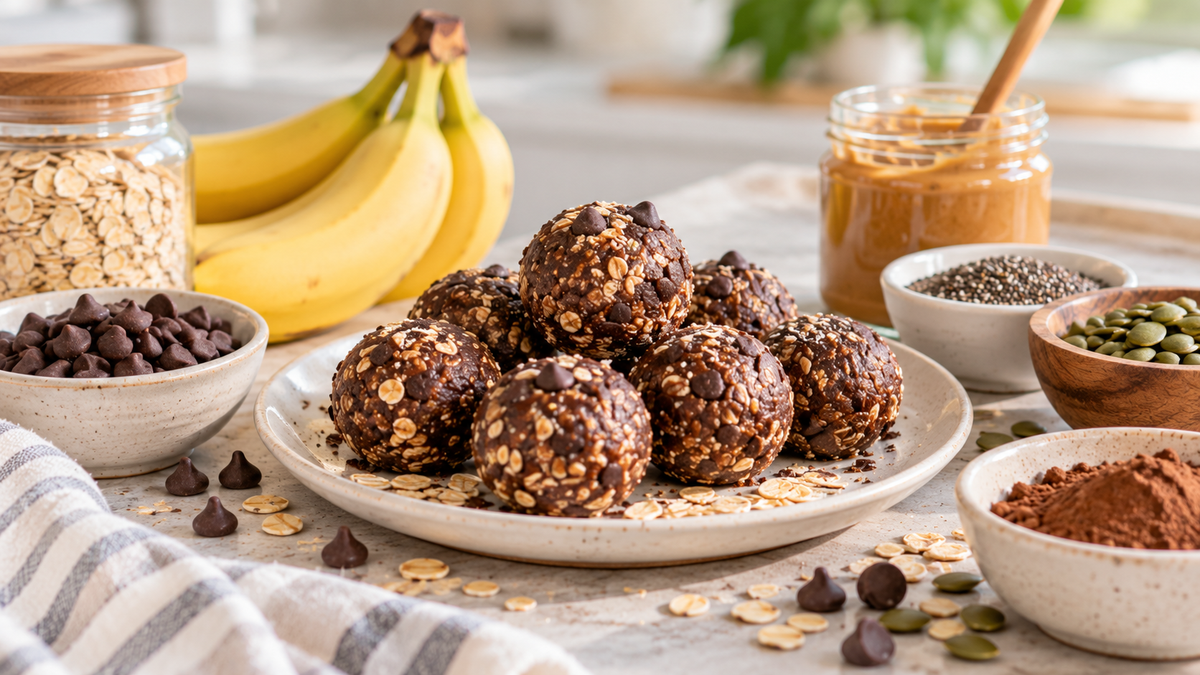
So this recipe hides the two best magnesium foods inside something that tastes like a chocolate truffle. No baking, no food processor required, fifteen minutes start to finish, and roughly 55 mg of magnesium per ball.
Below: the magnesium-rich foods worth knowing, how much kids actually need, the recipe, and the fixes for when the mixture refuses to hold together.
Why Magnesium Matters for Kids
Magnesium is a cofactor in more than 300 enzyme reactions, but four jobs matter most for a growing child.
- Energy. Magnesium is required to produce ATP, the molecule every cell runs on.
- Muscles. Calcium makes a muscle contract, magnesium helps it release. That pairing is why low magnesium shows up as cramps and twitches.
- Nerves. Magnesium regulates how readily nerve cells fire, which is the basis of its calming reputation.
- Bones. Roughly 50 to 60% of the body's magnesium sits in bone, alongside calcium.
The intake data is not reassuring. USDA analysis of national dietary surveys found nearly half of Americans aged 1 and over consuming less magnesium than they need, and more than two-thirds of 14 to 18 year olds falling short. Teenagers are the worst-served group, because their requirement jumps right when their diets narrow.
Worth being clear, though: true magnesium deficiency is uncommon in healthy children. What is common is simply not eating much of it. That is a food problem, and food fixes it.
Magnesium-Rich Foods for Kids
Magnesium is unusually concentrated in a handful of foods, which makes this easier than it looks:
| Food | Magnesium per serving |
|---|---|
| Pumpkin seeds, roasted (1 oz) | 156 mg |
| Chia seeds (1 oz) | 111 mg |
| Almonds (1 oz) | 80 mg |
| Spinach, boiled (½ cup) | 78 mg |
| Cashews (1 oz) | 74 mg |
| Peanuts (¼ cup) | 63 mg |
| Black beans, cooked (½ cup) | 60 mg |
| Dark chocolate, 70–85% (1 oz) | 64 mg |
| Edamame (½ cup) | 50 mg |
| Peanut butter (2 tbsp) | 49 mg |
| Rolled oats, dry (½ cup) | 56 mg |
| Brown rice (½ cup) | 42 mg |
| Plain yogurt (8 oz) | 42 mg |
| Banana (1 medium) | 32 mg |
| Whole wheat bread (1 slice) | 23 mg |
Look at the top five. Pumpkin seeds, chia seeds, almonds, oats and dark chocolate are the magnesium powerhouses — and four of those five go into the recipe below, which is not a coincidence.
One habit worth more than any single food: swap refined grains for whole grains where your child will accept it. Refining strips most of the magnesium out of wheat, so white bread and white pasta contribute very little.
How Much Magnesium Do Kids Need?
| Age | Magnesium per day |
|---|---|
| 1–3 years | 80 mg |
| 4–8 years | 130 mg |
| 9–13 years | 240 mg |
| 14–18 years (boys) | 410 mg |
| 14–18 years (girls) | 360 mg |
These targets are for magnesium from food and supplements combined. Magnesium from food has no upper limit, because healthy kidneys clear the excess without difficulty — so you cannot overdo it with pumpkin seeds. Supplemental magnesium is a different matter and has much lower ceilings, which is a separate conversation.
For the recipe below, two balls land at roughly 110 mg — most of a 4-to-8-year-old's daily magnesium, in something they will ask for again.
15-Minute No-Bake Chocolate Energy Balls
The pumpkin seeds are the whole trick here. Chopped coarsely they vanish into the chocolate, adding texture rather than announcing themselves.
Ingredients — makes about 16
- 1 cup rolled oats
- ½ cup pumpkin seeds, roasted and unsalted
- ¼ cup chia seeds
- ½ cup peanut butter (or sunflower seed butter)
- ⅓ cup honey or maple syrup
- 2 tbsp cocoa powder
- ¼ cup dark chocolate chips
- 1 tsp vanilla
- Pinch of salt
Method
- Chop the pumpkin seeds coarsely — a few pulses in a food processor, or a knife and thirty seconds. Stop well before they turn to powder. This is the step that hides them.
- Combine the dry ingredients: oats, chopped pumpkin seeds, chia, cocoa powder and salt. Mix so the cocoa is evenly distributed before anything wet goes in.
- Add peanut butter, honey and vanilla. Stir until a stiff dough forms. It should hold together when pressed, not crumble.
- Stir in the chocolate chips last, so they stay whole.
- Rest the mixture 5 minutes. The chia absorbs moisture and the dough firms up noticeably. Skipping this is the most common reason the balls won't roll.
- Roll into walnut-sized balls, about a tablespoon each. Damp hands stop them sticking.
- Chill 15 minutes before serving or storing.
Makes about 16 · Time 15 minutes · Magnesium roughly 55 mg per ball · Protein about 4 g per ball
Why This Recipe Works
Most energy ball recipes are oats, peanut butter and honey. This one is built around magnesium density, and the numbers are the reason.
Across the whole batch, the pumpkin seeds contribute roughly 390 mg of magnesium, the peanut butter about 195 mg, the chia around 150 mg, the oats about 110 mg, and the dark chocolate roughly 60 mg. That is around 900 mg of magnesium divided across 16 balls — call it 55 mg each.
Two balls after school is more magnesium than most children get from the rest of the day combined.
A fair caveat: these are calculated from standard USDA food values, not lab-tested, and the exact figure shifts with brands and how generously you fill a cup. The point is not the decimal place. It is that a snack built on seeds and oats delivers something a snack built on white flour simply does not.
The cocoa powder earns its place twice over, incidentally — it tastes like chocolate and it adds magnesium of its own.
Troubleshooting: Sticky, Crumbly or Won't Hold Together
Almost every energy ball problem is a moisture-balance problem, and all three have simple fixes.
Too sticky to roll. Add a tablespoon of oats, mix, and chill for 15 to 20 minutes. Repeat if needed. Natural-style peanut butters are much runnier than processed ones, so the same half cup behaves differently brand to brand.
Too dry and crumbly. Add a tablespoon of peanut butter or honey, mix, and test by squeezing a handful. Add one spoonful at a time rather than a glug — it goes from dry to sticky quickly. Old oats and stale seeds also absorb more.
Falls apart when rolled. Three usual causes. The nut butter had separated in the jar and needed stirring before measuring. Or the mixture did not rest long enough for the chia to absorb moisture — give it five minutes. Or it genuinely needs more binder, in which case a little more honey.
Sticks to your hands. Wet your palms with cold water between every few balls. It takes two seconds and makes the rolling almost pleasant.
Storage and Freezing
This is where the recipe earns its keep as a weekday snack.
In the fridge: an airtight container, 1 to 2 weeks. Because there is no fresh fruit in this version, it sits at the longer end of that range. Put a sheet of parchment between layers so they don't fuse.
In the freezer: freeze the rolled balls in a single layer on a tray for 1 to 2 hours until solid, then transfer to a labelled bag. They keep up to 3 months. Freezing them separately first is what stops them welding into one lump.
They are genuinely good eaten straight from the freezer — firmer, more like a truffle — or thawed for 10 to 15 minutes.
A double batch takes barely longer than a single one, and fills the snack gap for a month.
Swaps for Allergies and Picky Eaters
| Instead of | Use |
|---|---|
| Peanut butter | Sunflower seed butter (nut-free and school-safe) or tahini |
| Pumpkin seeds | Sunflower seeds, or finely chopped almonds if nuts are fine |
| Chia seeds | Ground flaxseed, same quantity |
| Honey | Maple syrup — and always maple for under-ones |
| Cocoa powder | Leave it out and add an extra 2 tbsp oats |
| Rolled oats | Certified gluten-free oats |
| Chocolate chips | Raisins, dried cranberries or more chopped seeds |
For a child who objects to visible seeds, blitz the pumpkin seeds finer — close to a coarse flour. You lose a little texture and nothing else.
For a child who objects to anything brown and unfamiliar, make the first batch without cocoa and with chocolate chips visible. Chocolate chips do a lot of diplomatic work.
More Easy Ways to Get Magnesium into Kids
The energy balls are the set piece. These are the everyday ones:
- Pumpkin seed sprinkle. Blitz roasted pumpkin seeds coarse and keep a jar on the table. Over pasta, rice, soup or yogurt it reads as a topping rather than a seed. A tablespoon adds roughly 75 mg.
- Chocolate banana smoothie. Banana, peanut butter, milk, cocoa powder and a spoon of chia. Around 100 mg, and it drinks like a milkshake.
- Overnight oats with chia. Oats, yogurt and a tablespoon of chia, made the night before. About 90 mg.
- Black beans in things they already eat. Quesadillas, tacos, chilli. Half a cup adds 60 mg.
- Spinach where it disappears. A handful blitzed into a fruit smoothie or stirred into pasta sauce is invisible and adds 78 mg per half cup cooked.
- Dark chocolate as the default treat. 70% or higher carries real magnesium, and it is a straight swap for milk chocolate.
Frequently Asked Questions
How much magnesium is in these energy balls?
Roughly 55 mg per ball, calculated from standard USDA food values — about 900 mg across a batch of 16. Two balls covers most of a 4-to-8-year-old's daily magnesium requirement of 130 mg.
Can toddlers eat these energy balls?
Whole nuts and seeds are a choking risk under four, and these contain chopped seeds. For younger toddlers, blitz the pumpkin seeds to a fine flour, flatten the balls into small discs rather than spheres, and supervise closely. Use maple syrup rather than honey for anyone under 12 months.
Why won't my energy balls hold together?
Usually the mixture needed to rest longer so the chia could absorb moisture, or the peanut butter had separated and needed stirring before measuring. Five minutes of resting fixes most batches. If it is still crumbly, add honey a spoonful at a time.
Can I make these without a food processor?
Yes. Chop the pumpkin seeds with a knife and mix everything in a bowl with a sturdy spoon. The dough is stiff, so a wooden spoon beats a spatula. Nothing in this recipe needs a machine.
How long do energy balls last?
One to two weeks in an airtight container in the fridge, and up to three months in the freezer if you freeze them in a single layer first before bagging them.
Can kids get too much magnesium from food?
No. Magnesium from food has no upper limit, because healthy kidneys clear what isn't needed. Supplemental magnesium is different and does have age-based limits — but you cannot overdo it with pumpkin seeds and oats.
Related articles
Shop Here 👇
Anastasia Glover writes about family nutrition and children's well-being for Sunny Sam.
This article is for informational purposes only and is not medical advice. Check recipes against your child's allergies, avoid honey before 12 months, and supervise young children with foods that may pose a choking risk.